


Are MQLs the right thing to attribute?
MQL attribution credits marketing-qualified leads by channel at the MQL stage. B2B attribution keeps Visit, Pages, Meeting, and Deal on one path so CAC and channel quality stay honest. That is the split when teams ask about MQL attribution vs B2B attribution.
CRM stage reports answer which channels produced MQLs. Those counts help marketing ops track funnel volume. They rarely answer which Visits became Meetings and closed Deals once sales entered the path.
We already covered lead source attribution vs B2B attribution and opportunity attribution vs B2B attribution. This post is the next funnel-stage cut: MQL stage credit versus the Visit to Pages to Meeting to Deal path B2B teams need for honest CAC.
What does MQL attribution actually credit?
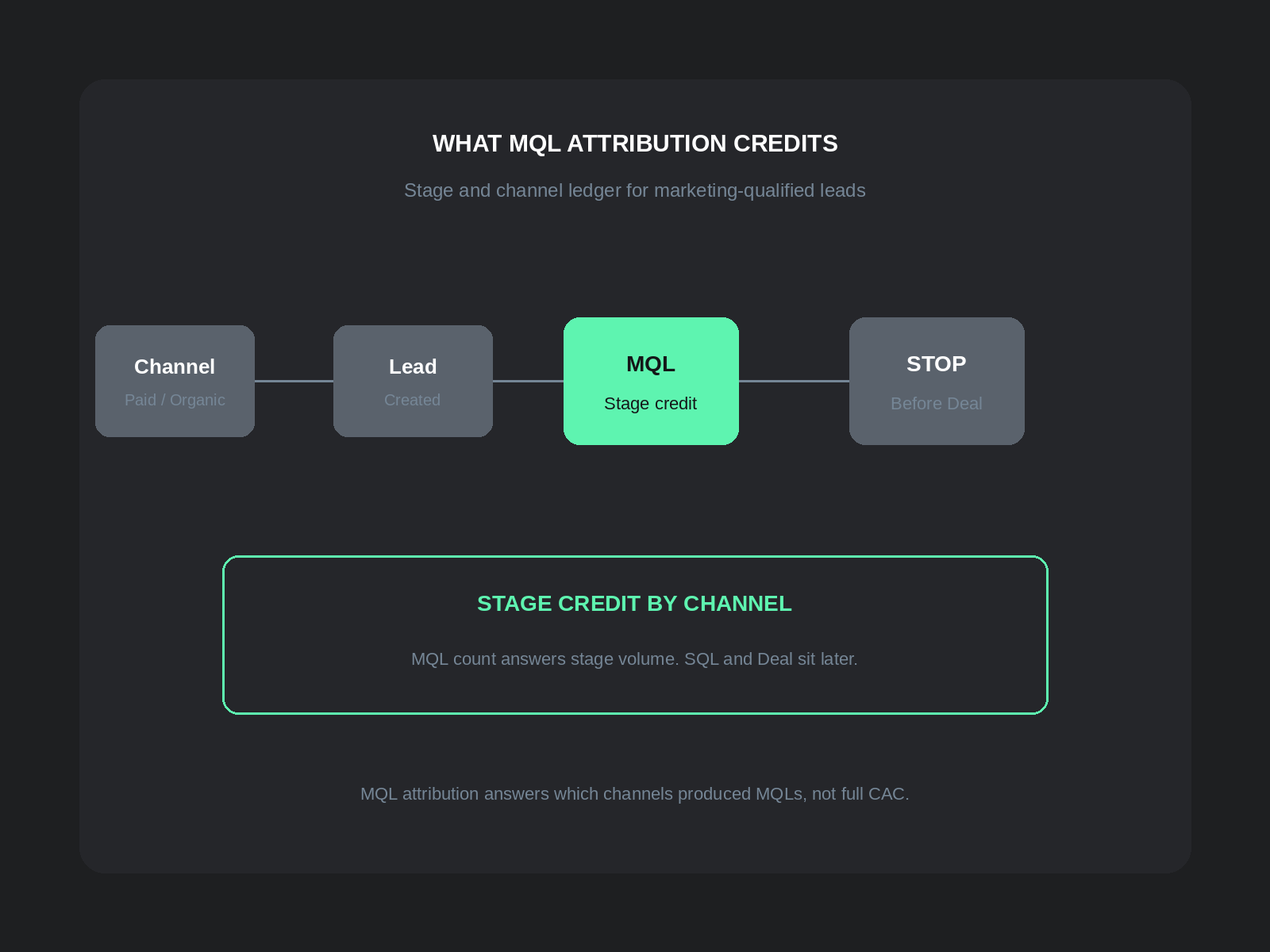
MQL attribution credits the channel (or touch) tied to a lead when it hits marketing-qualified status. Paid search, content, partner pages, and outbound can all own an MQL in the stage ledger. The report answers how many MQLs each channel produced in the window.
Tools such as HubSpot and other CRMs make that stage ledger easy to ship. Lifecycle filters, deal stages, and channel properties show MQL volume by source without rebuilding every Visit into a Meeting or closed-won Deal.
So an MQL can look like channel ROI while Meetings and Deals still sit outside the cost ledger. Stage credit answers which channels produced MQLs. It does not answer whether Visit, Pages, Meeting, and Deal stayed together for CAC.
Teams also use MQL reports for SQL attribution prep: which MQLs later become SQLs, which channels stall between MQL and SQL, and where sales rejects stage quality. That is useful funnel hygiene. It is still stage credit, not channel CAC across the full path.
What does B2B attribution keep on one path?
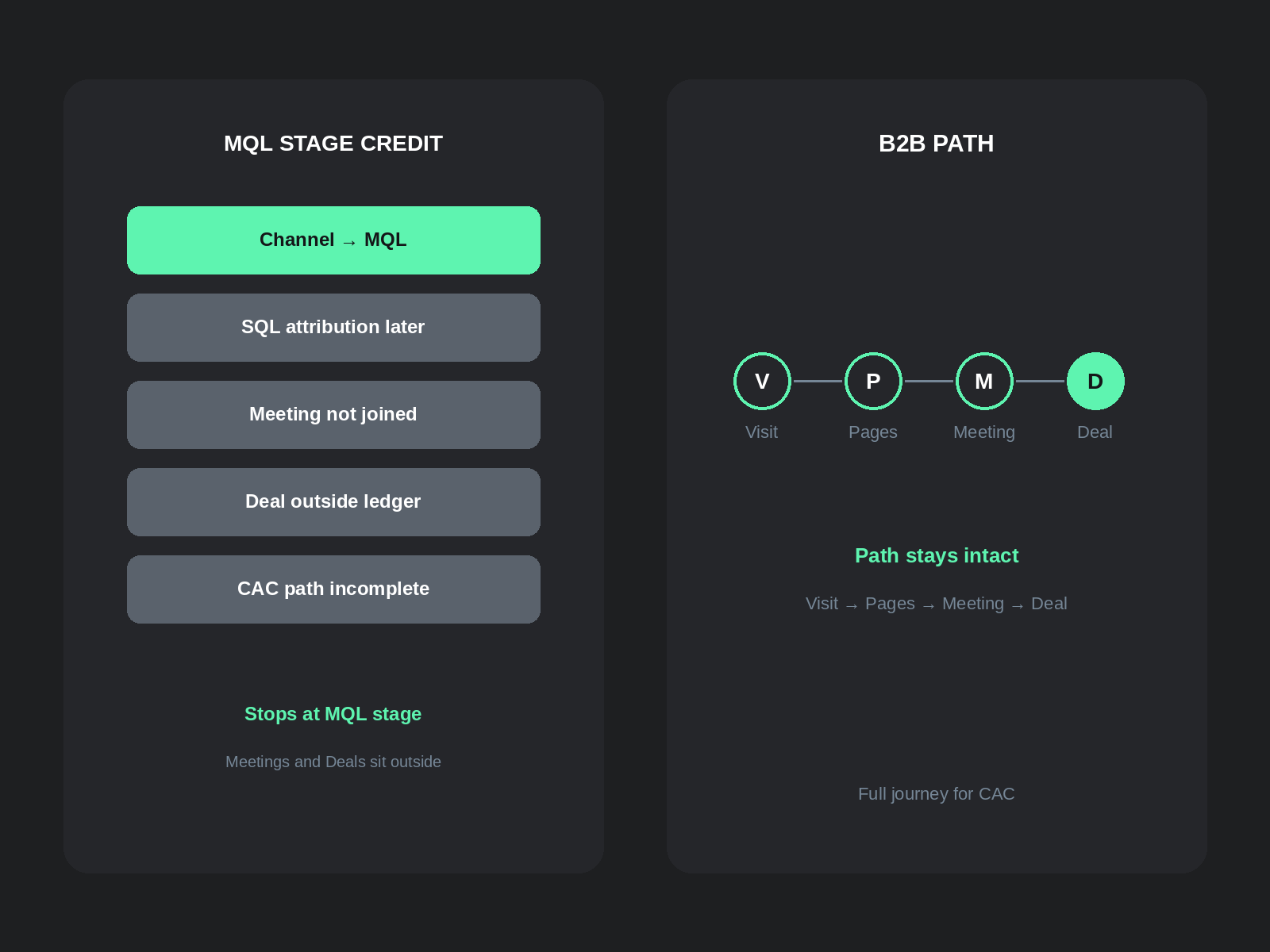
B2B attribution keeps the full path on one timeline: Visit, Pages, Meeting, Deal. Multi-touch models can weight first Visit, content that returned the buyer, and the Meeting that opened the Opp. View-through, offline, and LLM traffic can sit on that same path when the pixel and CRM sync capture them.
The point is continuity. Spend and channel quality stay tied to the Visits that became Meetings and closed revenue, not only to MQL stage counts. That is how CAC stays honest when a buyer touches paid search, a partner page, and a sales demo before closed-won.
MQL stage reports still matter for funnel volume. They sit beside the path instead of replacing it. When both stay in sync, MQL and SQL counts can show stage health while Visit to Deal still carries cost for CAC.
Where MQL stage credit breaks CAC
CAC needs cost next to the path that produced closed revenue. MQL attribution usually stops when the lead hits marketing-qualified. Everything after that stage (SQL handoff, sales Meeting, Opp create, closed-won Deal) can sit outside the MQL ledger even when those Visits booked the Meeting.
Teams then overstate MQL channels as if they were full CAC owners. Paid looks busy in the MQL report. Sales CAC looks wrong because spend never meets the Visit to Deal path. Multi-touch on the B2B path fixes that join. MQL counts alone do not.
The same gap shows up when marketing goals are MQL volume while finance asks for CAC by channel. Stage credit still moves on the CRM funnel. The Meeting and Deal history that should explain CAC does not. If your board asks for CAC by channel, MQL stage credit is the wrong unit of measure.
Lead source fields name the first touch. MQL attribution names the stage. Neither joins spend through Meeting and Deal unless the B2B path is kept intact. That join is what keeps CAC honest when finance asks for channel cost next to closed revenue.
When teams still need both
Use MQL attribution when the question is stage volume: which channels produced MQLs, how SQL attribution looks after handoff, and where stage quality stalls. That view belongs to marketing ops and demand gen reviewing funnel health.
Use B2B path attribution when the question is marketing efficiency: which Visits and channels produced Meetings and closed-won Deals, and what CAC looks like when those Visits carry cost. That view belongs next to budget and channel quality reviews.
They fight when leadership treats MQL volume as proof of channel ROI. An MQL can earn stage credit while paid Visits weeks earlier still need the cost ledger tied through Meeting and Deal. Keep MQL reports for stage volume. Keep Visit to Deal for CAC. For the next funnel stage, see SQL attribution vs B2B attribution.
How Source connects the path
Source connects that path with one pixel and GTM: multi-touch, view-through, offline, and LLM attribution (ChatGPT, Claude, Perplexity, Gemini) on Visit to Pages to Meeting to Deal. Chat with the data, get AI recommendations, and daily Slack reports without a warehouse. Customer data is not used to train external models. SOC 2 Type II and ISO 27001 cover the security bar.
Ready to keep MQL stage credit and the Deal path honest in the same stack? Start free at dash.source.app/signup.