


Revenue attribution vs B2B attribution
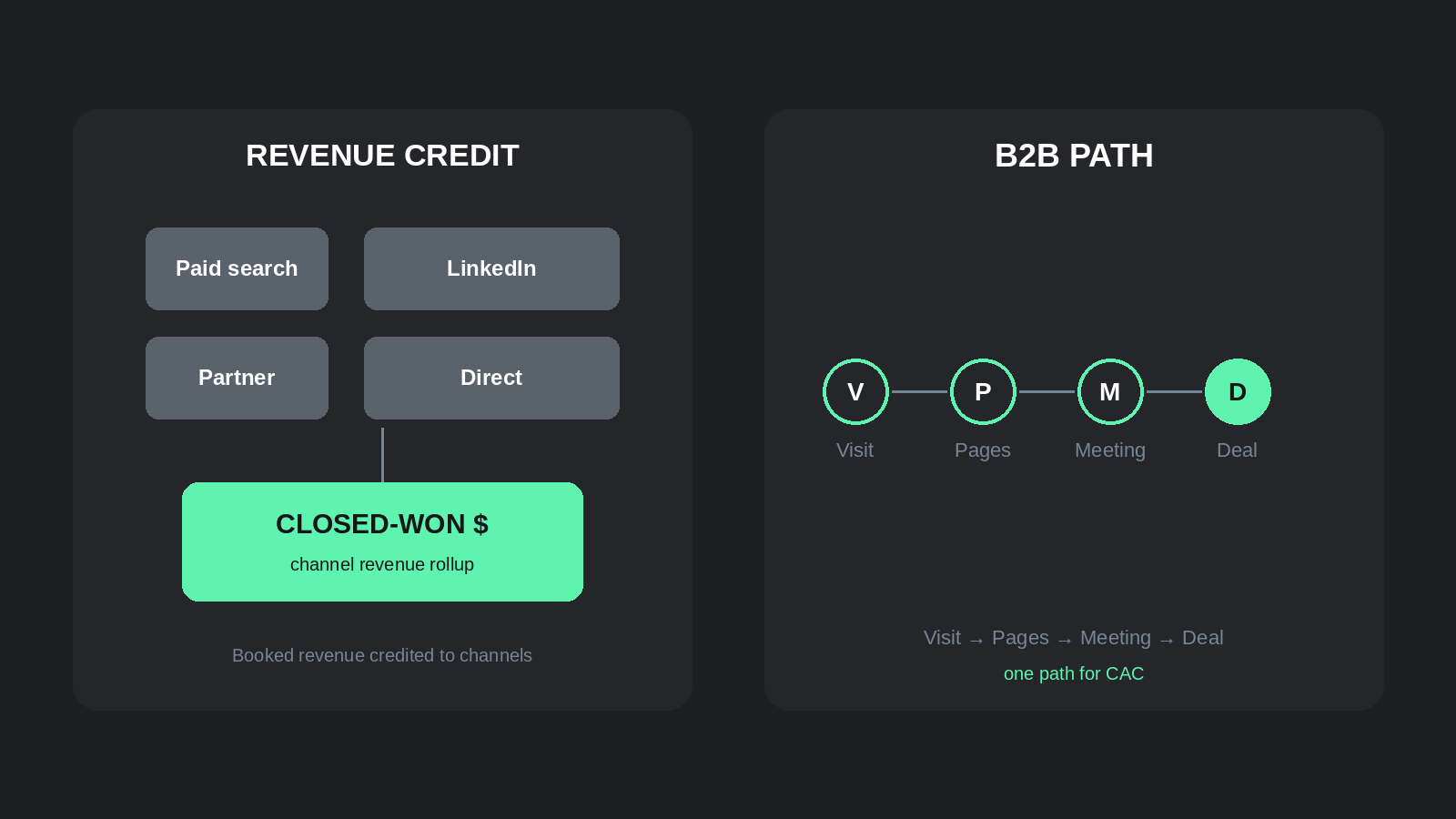
Revenue attribution credits closed-won dollars to channels. B2B attribution keeps Visit, Pages, Meeting, and Deal on one path so CAC and channel quality stay honest. That is the split when teams ask about revenue attribution vs B2B attribution.
Finance and growth often need a booked-revenue rollup: which channels own the closed-won dollars after a Deal marks Closed Won. That view answers closed-won credit. It is not the same as tying spend to the Visits that became Meetings and Deals along the way.
We already covered pipeline attribution vs B2B attribution and account-based attribution vs B2B attribution. This post is the next cut: closed-won dollar credit versus the Visit → Pages → Meeting → Deal path B2B teams need for honest CAC.
What does revenue attribution actually credit?
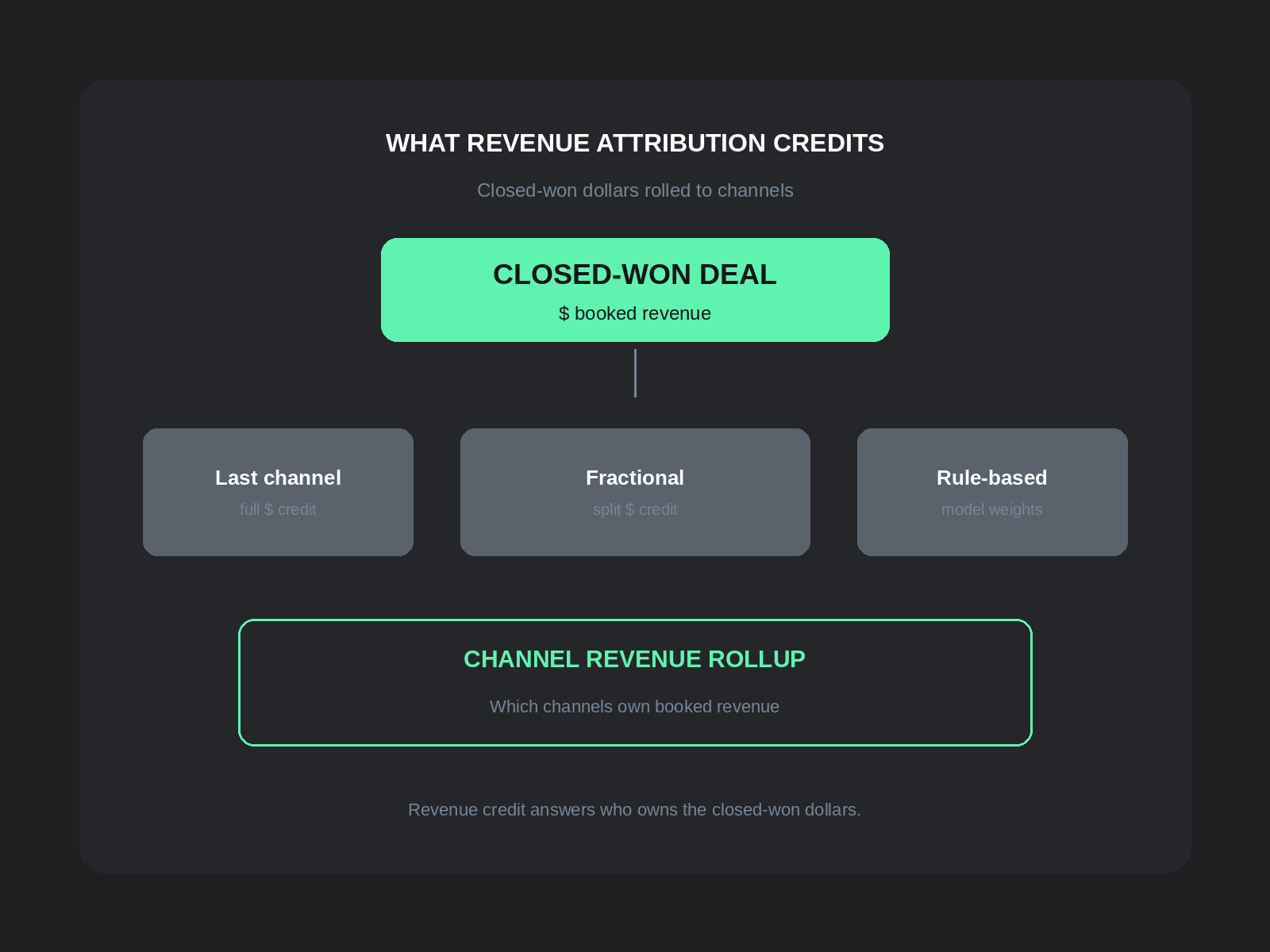
Revenue attribution credits booked revenue. When a Deal closes won, the closed-won amount gets assigned to channels by a rule: last channel before close, fractional split across listed touches, or another model weight. The output is a channel revenue rollup so leadership can see which programs own closed-won credit.
Tools such as HubSpot revenue reports and similar CRM dashboards make that rollup easy to ship. Marketing and finance can share one closed-won dollar view without rebuilding every Visit on the path.
So a channel can look strong on closed-won dollars while the Visits that opened the Opportunity still sit outside the cost ledger. Multi-touch weight on late touches can feed the rollup. The rollup still answers which channels own booked revenue, not whether Visit, Pages, Meeting, and Deal stayed together for CAC.
What does B2B attribution keep on one path?
B2B attribution has to keep the journey together. A Visit lands from ads, search, a partner, an LLM such as ChatGPT, Claude, Perplexity, or Gemini, or elsewhere. Pages get read. A Meeting gets booked. A Deal moves in the CRM. Later returns can show up as Direct or as another Visit from the same account.
Pipeline stage credit and closed-won dollar credit can sit on top of that path when you want shared views. Revenue rollups sit beside the path as a finance view of booked dollars. Neither replaces the path. Without Visit → Pages → Meeting → Deal, CAC still collapses into closed-won totals that never name the Visits that opened the Opportunity.
Source is built around that path with one pixel and GTM, no warehouse required: Visit → Pages → Meeting → Deal in one place, with chat over the data and daily Slack reports when you want them. View-through, offline steps, and LLM attribution stay on the same ledger when they belong there. Source does not invent a separate closed-won scoreboard that floats apart from the path.
Where closed-won credit hides path cost
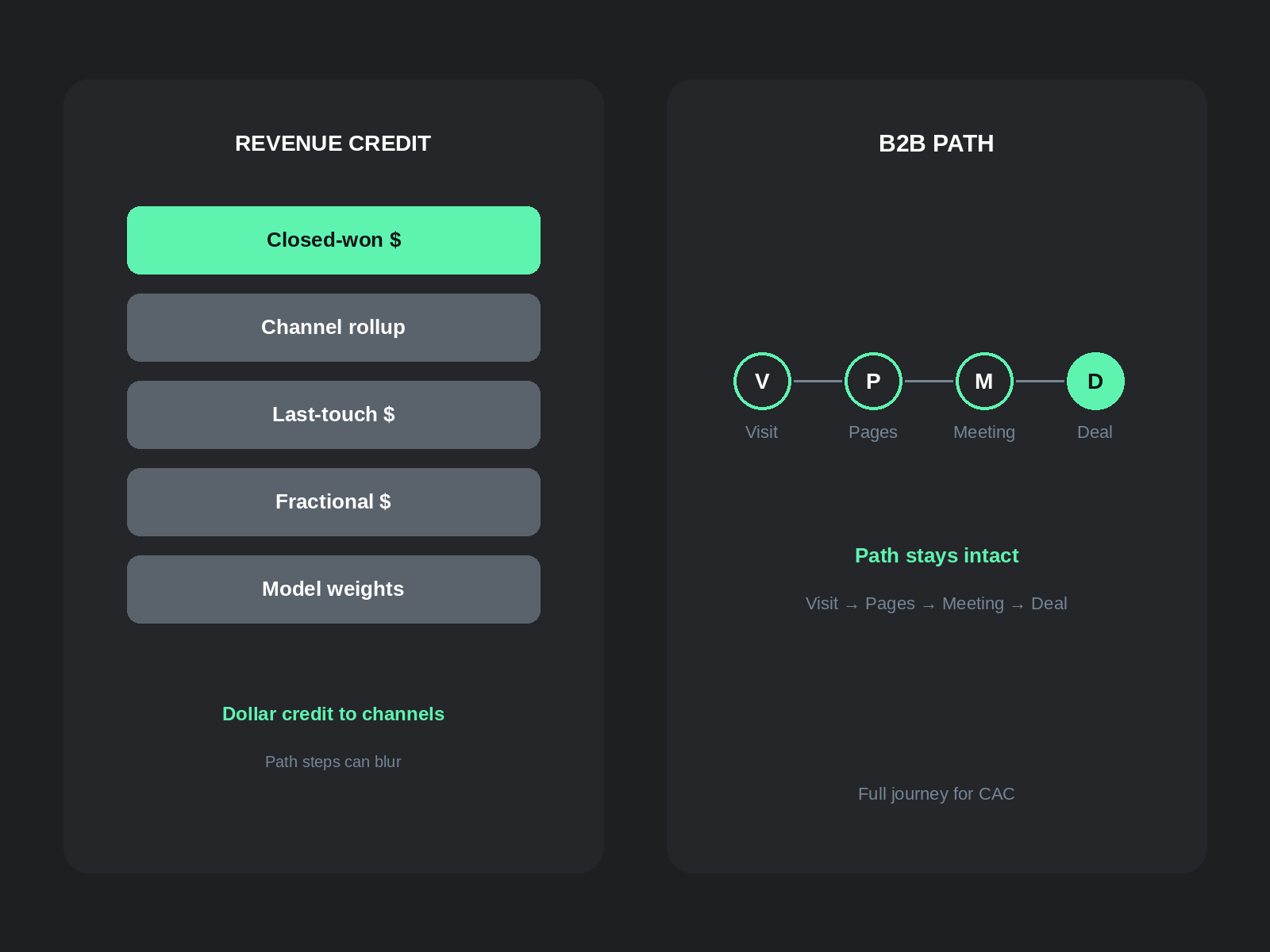
Closed-won credit hides path cost when teams treat a strong revenue channel as proof that CAC is healthy. A channel can own a large share of closed-won dollars because it sat last before Close Won while paid search still owns the only Visits that booked Meetings. The revenue report looks clean. CAC still needs those Visits on the ledger.
It also hides cost when research Visits, view-through Visits, or calendar bookers never enter the revenue model until late. The channel can still look efficient on booked revenue while the path that created demand stays off the spend report. Teams then argue about which channels own closed-won credit instead of whether channel quality and CAC can be trusted.
B2B cycles make this worse. Long sales paths accumulate touches that a last-channel or fractional revenue rule blurs. Closed-won credit and pipeline stage credit can both look consistent and still disagree with the Visits that opened the Deal. Later Direct or LLM returns get undercounted when they never join the Visit → Pages → Meeting → Deal path cleanly. CAC then looks tighter on closed-won rollups than the full path supports.
Sales-assisted deals make the gap obvious. An SDR books a Meeting after weeks of Visits. The Opportunity opens days later. Closed-won credit often lands on the channel closest to Close Won. Path-level B2B attribution still needs those earlier Visits and the Meeting on the same ledger, or channel quality and CAC drift toward whatever campaign sat nearest the closed-won stamp.
When teams use both
Keep revenue attribution as a booked-revenue view. It is useful for asking which channels own closed-won dollars and how closed-won credit lands after Deal stages. It is a weak sole answer for which Visits and Meetings drove those Deals at an honest CAC.
Pair it with path-level B2B attribution. Compare channel revenue rollups against the full Visit → Pages → Meeting → Deal chain. Watch for assisted steps, offline Meetings, view-through Visits, and later Direct or LLM returns. That is how you keep CAC honest without throwing away closed-won credit reports.
For CRM stage credit next to the same path question, see pipeline attribution vs B2B attribution. For CRM-wide contact and deal credit, see CRM attribution vs B2B attribution. For how closed-loop feedback sits on the same path, see closed-loop attribution vs B2B attribution.
Revenue attribution is still useful when you need closed-won dollar credit for finance. Just do not confuse a channel revenue rollup with a complete Visit → Pages → Meeting → Deal ledger. Path completeness decides whether CAC and channel quality can be trusted.
How Source approaches this
Source keeps closed-won Deals on the same path as the Visits that created them. One pixel and GTM capture the Visit. Pages, Meetings, and Deals stay attached when they happen. Multi-touch and view-through credit can sit on that path when you want them. AI recommendations and daily Slack reports surface channel quality without a warehouse.
Customer data is not used to train external models. Source is SOC 2 Type II and ISO 27001. The product goal stays the same: real CAC and goals tied to Visit → Pages → Meeting → Deal, including Deals that look clean on a closed-won revenue rollup and still need channel cost on the path.
FAQ
Is revenue attribution the same as closed-won credit?
Most teams use revenue attribution for closed-won dollar credit to channels. That rollup is not the same as path-level B2B attribution for CAC.
Does a revenue rollup replace B2B attribution?
No. Revenue credit answers which channels own booked dollars. B2B attribution answers whether Visit, Pages, Meeting, and Deal stay on one path for CAC.
How does pipeline attribution fit?
Pipeline attribution credits stages before Close Won. Revenue attribution credits booked dollars after Close Won. Path-level attribution still has to keep Visits connected to later Meetings and Deals.
If you want that path in one place, start free at dash.source.app/signup or read more on source.app.