


Dark social attribution vs B2B attribution
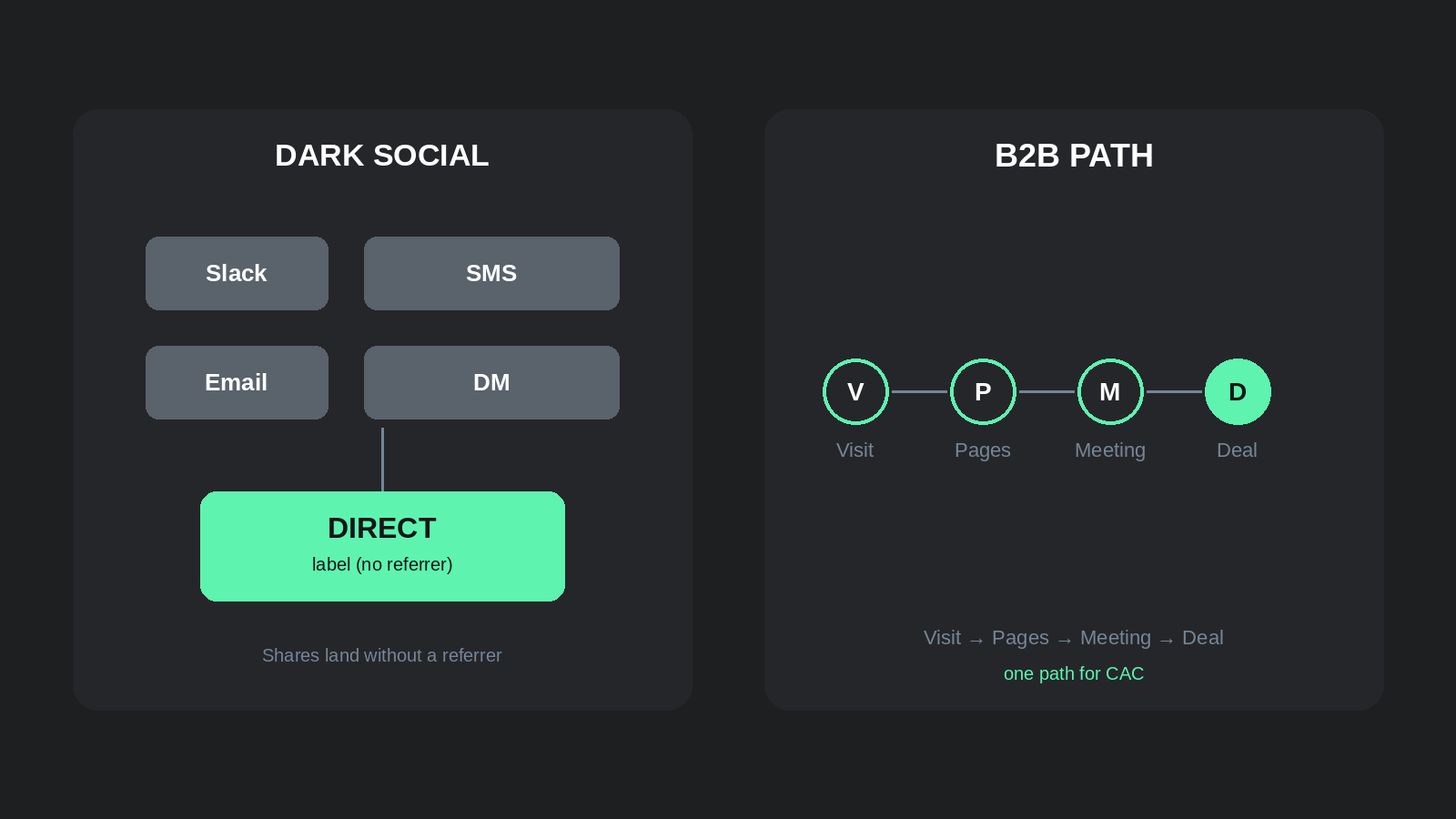
Dark social attribution finds Slack, SMS, and email shares that analytics often labels Direct because the link carried no referrer. B2B attribution keeps Visit, Pages, Meeting, and Deal on one path so CAC and channel quality stay honest. That is the split when teams ask about dark social attribution vs B2B attribution.
Direct traffic and LLM referral both hide how a buyer first heard about you. Dark social is the private-share version of that problem. The Visit still happened. The label just lost the share path.
We already covered LLM attribution for ChatGPT traffic and closed-loop attribution vs B2B attribution. This post is the next cut: shared links that look like Direct versus the Visit -> Pages -> Meeting -> Deal path B2B teams need for honest CAC.
What counts as dark social attribution?
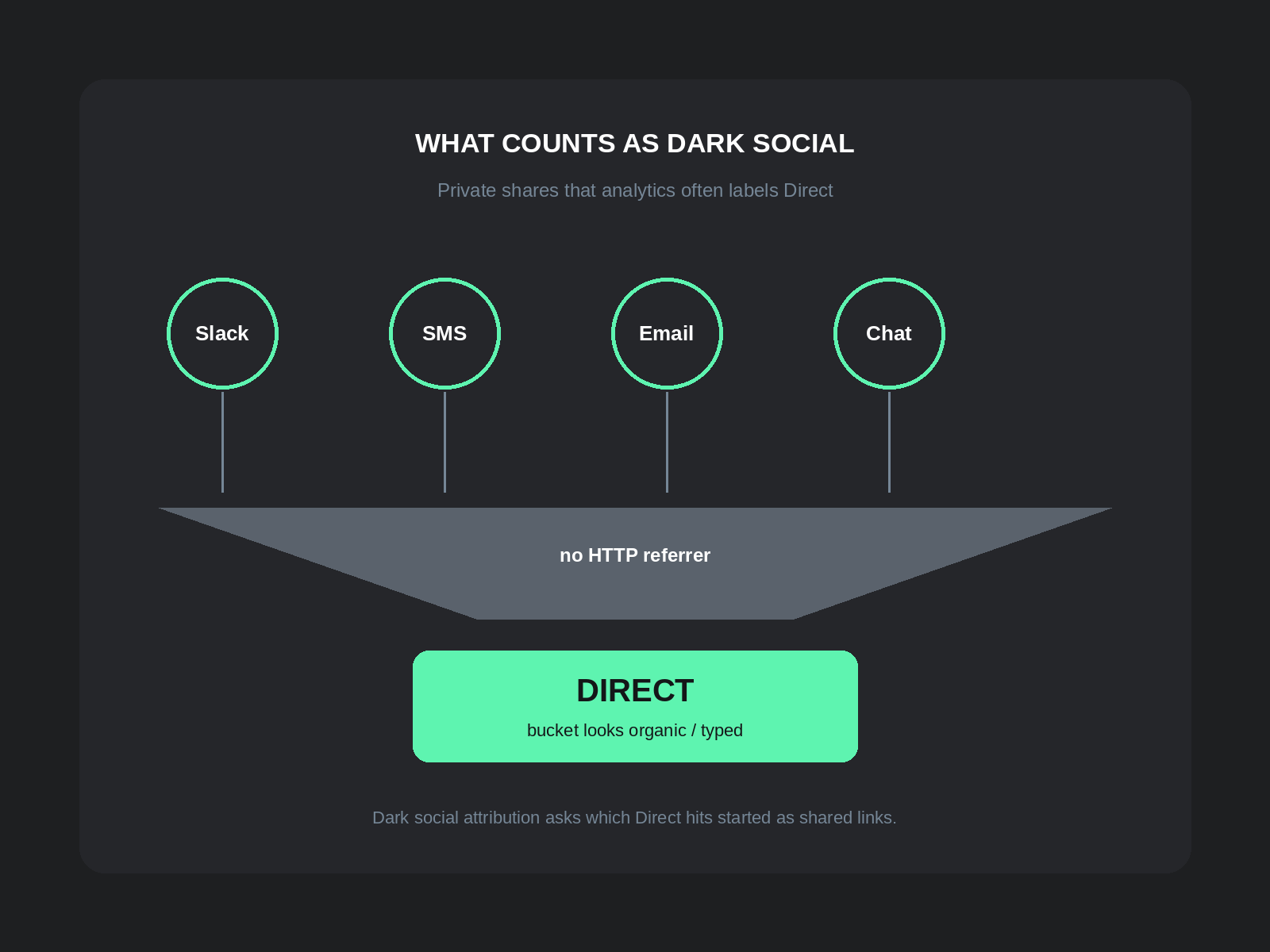
Dark social attribution covers private share paths that analytics cannot see as a named referrer. Someone pastes a product URL into Slack. A teammate texts a blog link. An AE forwards a case study in email. A buyer opens the link on a phone that strips the referrer. The session lands under Direct.
The Visit is real. The channel label is wrong for how demand started. Dark social attribution asks which Direct hits began as shared links, then ties those Visits forward when a Meeting or Deal shows up later.
It is not a separate product category from path-level B2B attribution. It is a label problem on top of the same Visit ledger. Tools such as Google Analytics and many CRM dashboards still bucket those sessions as Direct unless you recover the share context another way.
Why does dark social show up as Direct?
Browsers and apps drop the HTTP referrer when a link leaves a private surface. Slack, SMS, email clients, and many chat apps open the destination without passing a referrer string. Analytics then has nothing to name except Direct.
Typed URLs, bookmarks, and some LLM exits do the same thing. That is why Direct becomes a pile: real organic typed traffic, dark social shares, and later returns from ChatGPT, Claude, Perplexity, or Gemini can sit in one bucket. Teams then treat Direct as brand strength when part of it is shared demand they never measured.
UTM tags help when people remember to add them. Shared links inside companies often skip UTMs. The buyer still Visits. CAC reporting still loses the share origin unless the Visit stays connected to later Pages, Meetings, and Deals on one path.
What does B2B attribution have to keep on the path?
B2B attribution has to keep the journey together. A Visit lands from ads, search, a partner share, dark social, or elsewhere. Pages get read. A Meeting gets booked. A Deal moves in the CRM. Later returns can show up as Direct or as traffic from ChatGPT, Claude, Perplexity, or Gemini.
Multi-touch credit can sit on top of that path when you want a shared view across Visits. Dark social recovery sits inside it as a way to stop treating every Direct hit as typed brand traffic. Neither replaces the path. Without Visit -> Pages -> Meeting -> Deal, CAC still collapses into channel totals that never name the Visits that opened the Opportunity.
Source is built around that path with one pixel and GTM, no warehouse required: Visit -> Pages -> Meeting -> Deal in one place, with chat over the data and daily Slack reports when you want them. View-through, offline steps, and LLM attribution stay on the same ledger when they belong there. Source does not invent a separate dark-social scoreboard that floats apart from the path.
When do teams need both?
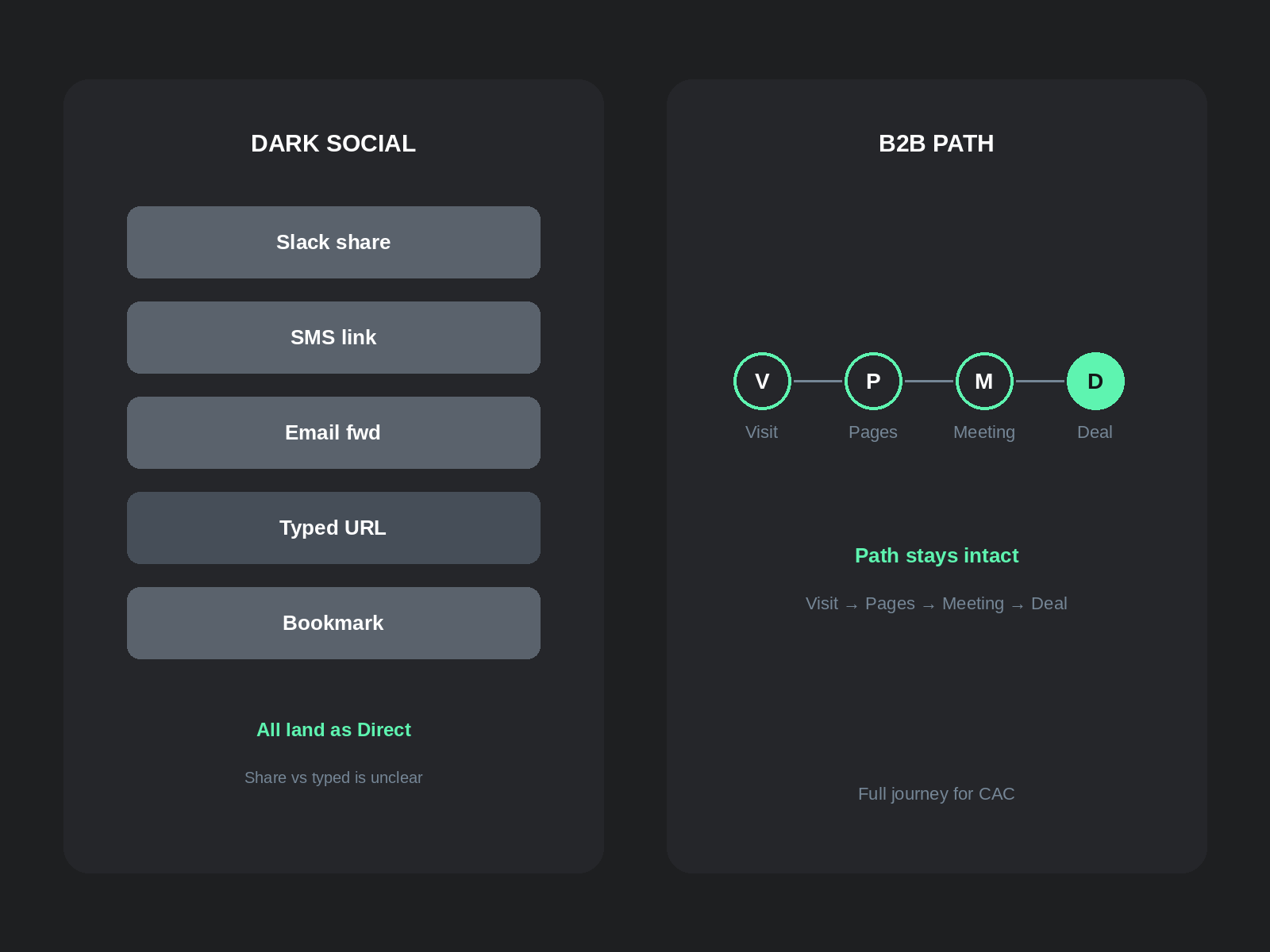
Keep dark social attribution as a Direct cleanup view. It is useful for asking which Visits started as Slack, SMS, or email shares instead of typed URLs. It is a weak sole answer for which Meetings and Deals those Visits eventually supported.
Pair it with path-level B2B attribution. Compare the Direct pile against the full Visit -> Pages -> Meeting -> Deal chain. Watch for assisted steps, offline Meetings, view-through Visits, and later Direct or LLM returns. That is how you keep CAC honest without throwing away Direct reporting.
For how view-through Visits belong on the same ledger, see view-through attribution for B2B. For what the path has to connect, see what B2B attribution has to connect. For GA4 channel labels next to the same path question, see GA4 vs B2B attribution.
Dark social attribution is still useful when Direct is bloated with shared links. Just do not confuse a cleaner Direct label with a complete Visit -> Pages -> Meeting -> Deal ledger. Path completeness decides whether CAC and channel quality can be trusted.
How Source approaches shared-link paths
Source keeps shared-link Visits on the same path as paid, organic, and LLM Visits. One pixel and GTM capture the Visit. Pages, Meetings, and Deals stay attached when they happen. Multi-touch and view-through credit can sit on that path when you want them. AI recommendations and daily Slack reports surface channel quality without a warehouse.
Customer data is not used to train external models. Source is SOC 2 Type II and ISO 27001. The product goal stays the same: real CAC and goals tied to Visit -> Pages -> Meeting -> Deal, including Visits that started as dark social shares and later looked like Direct.
FAQ
Is dark social the same as Direct traffic?
No. Dark social is a share path that often lands under Direct because the referrer is missing. Direct also includes typed URLs, bookmarks, and other no-referrer Visits.
Does fixing Direct replace B2B attribution?
No. Cleaning Direct answers how some Visits started. B2B attribution answers whether Visit, Pages, Meeting, and Deal stay on one path for CAC.
How is this related to LLM referral?
Both hide a clean referrer. LLM exits and dark social shares can inflate Direct. Path-level attribution still has to keep those Visits connected to later Meetings and Deals.
If you want that path in one place, start free at dash.source.app/signup or read more on source.app.