


Incrementality testing vs B2B attribution
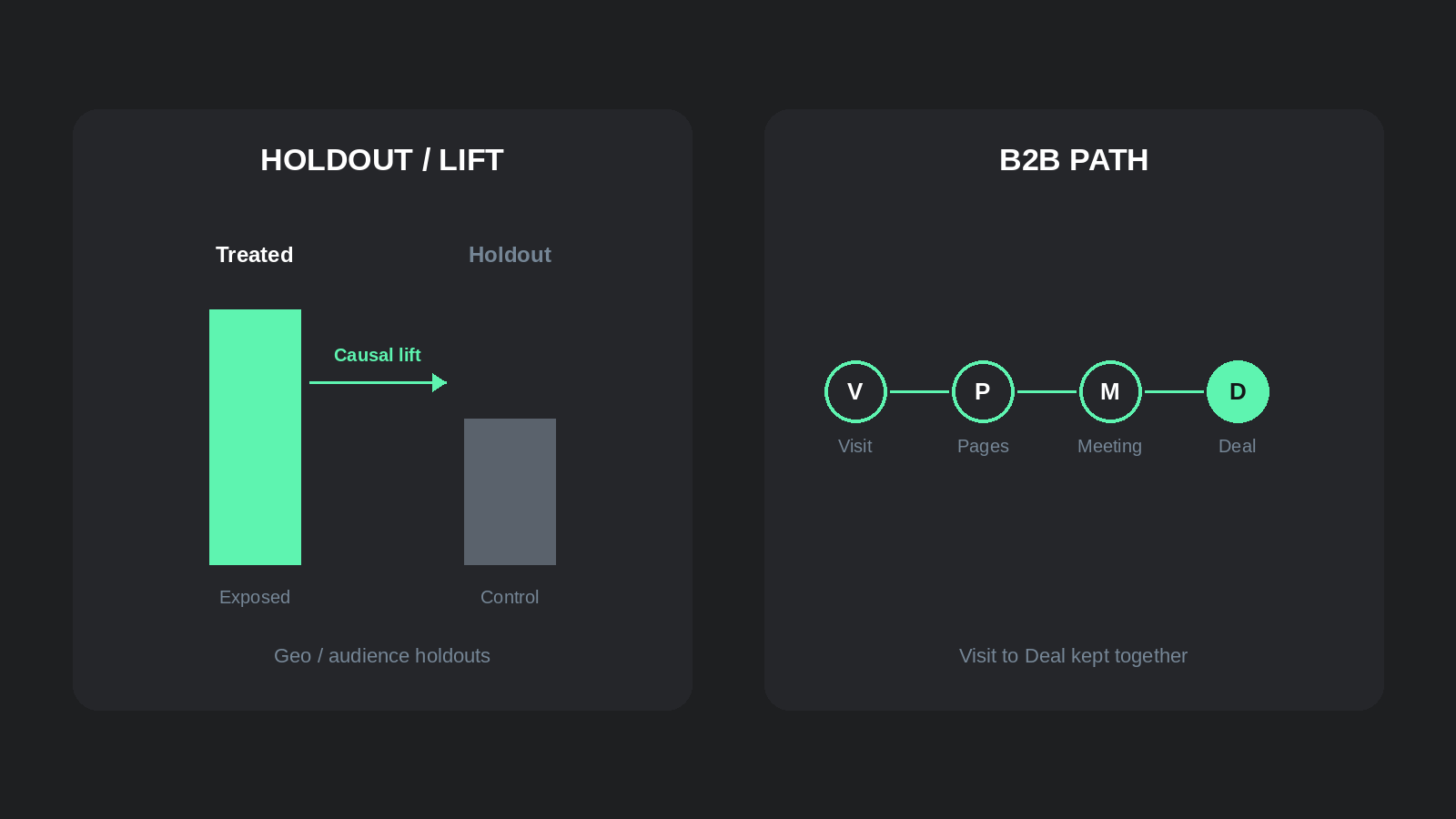
Incrementality testing estimates causal lift by comparing treated and holdout groups. B2B attribution keeps Visit, Pages, Meeting, and Deal on one path so CAC and channel quality stay honest. That is the real split when teams ask about incrementality testing vs B2B attribution.
Holdout tests, geo experiments, and audience splits answer whether a campaign moved outcomes beyond what would have happened anyway. They do not rebuild a single buyer's Visit → Pages → Meeting → Deal path.
We already covered marketing mix modeling vs B2B attribution and multi-touch attribution vs B2B attribution. This post is the next cut: causal lift experiments versus the path ledger B2B revenue teams need for honest CAC.
What does incrementality testing actually estimate?
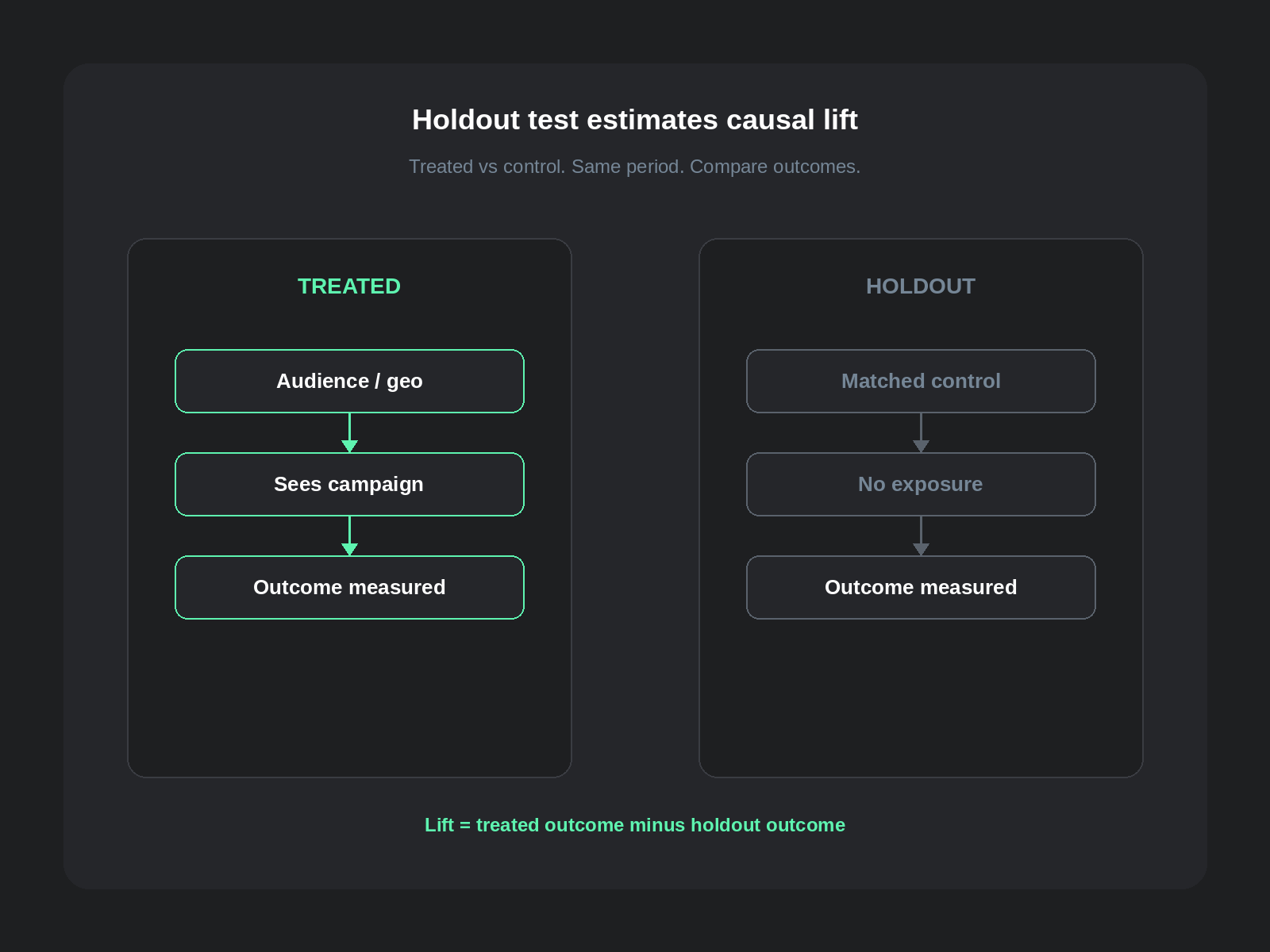
Incrementality testing holds back a matched control (geo, audience, or random holdout) while the treated group sees the campaign. Teams compare outcomes in the same window and treat the gap as causal lift.
The method is useful when you need to know whether spend created demand that would not have shown up on its own. Platforms such as Google Ads and Meta advertise conversion-lift and geo-style experiments for that question. The result is a portfolio-level read on lift, not a rebuilt buyer path.
So a lift report can look rigorous while the Meetings and Deals that closed revenue still sit off the ledger.
What does B2B attribution have to keep on the path?
B2B attribution has to keep the journey together. A Visit lands from ads, search, a partner, or elsewhere. Pages get read. A Meeting gets booked. A Deal moves in the CRM. Later returns can show up as Direct or as traffic from ChatGPT, Claude, Perplexity, or Gemini.
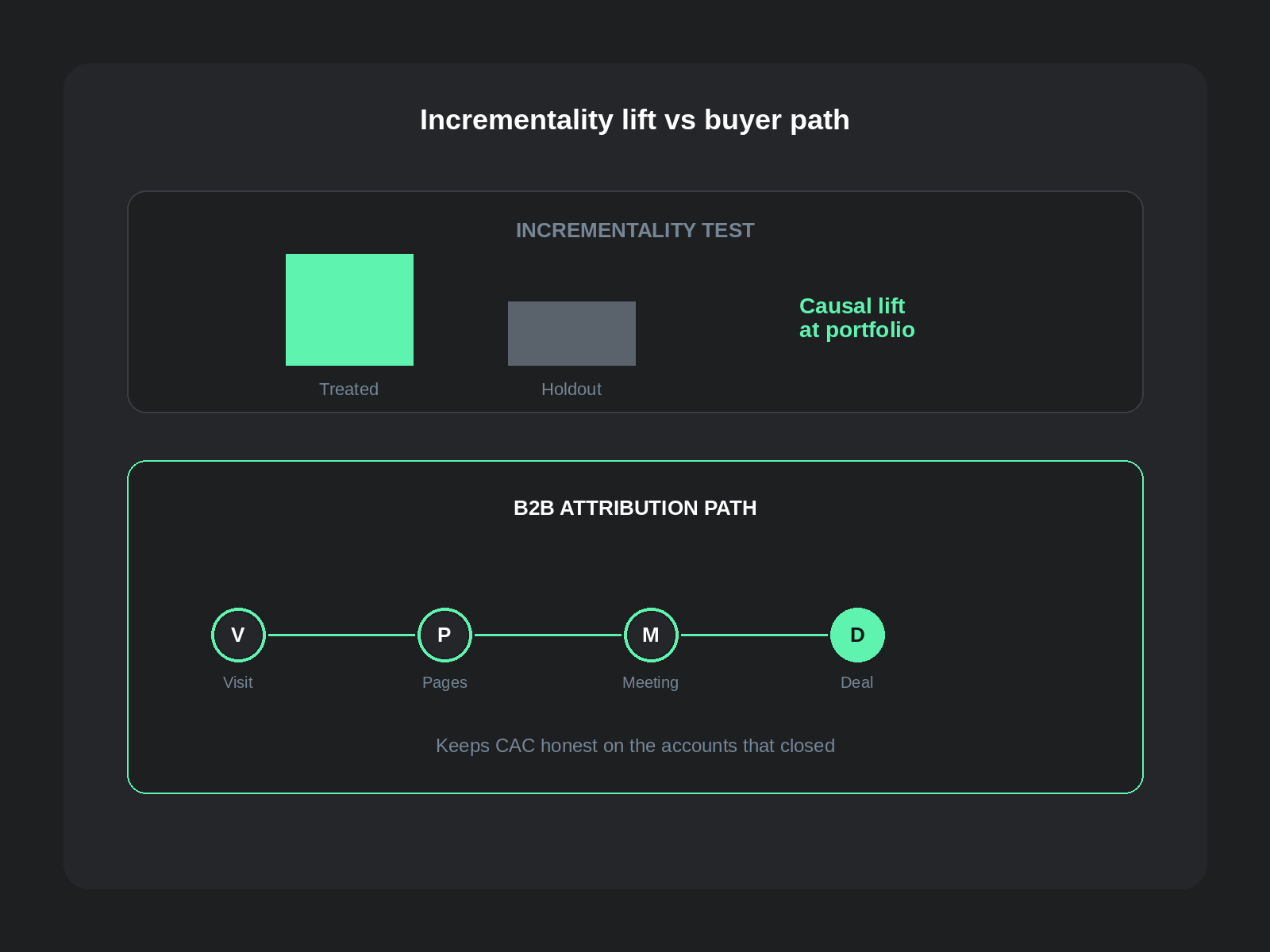
Multi-touch credit can sit on top of that path when you want a shared view across Visits. Incrementality sits beside it as a causal lift view. Neither replaces the path. Without Visit → Pages → Meeting → Deal, CAC still collapses into campaign totals or lift that never names the Meetings that closed revenue.
Source is built around that path with one pixel and GTM, no warehouse required: Visit → Pages → Meeting → Deal in one place, with chat over the data and daily Slack reports when you want them. View-through and offline steps stay on the same ledger when they belong there. Source does not claim to replace incrementality testing.
When does incrementality testing mislead CAC and channel quality?
Incrementality misleads CAC when teams treat portfolio lift as if it were the cost to acquire a closed Deal. Lift at the experiment level is not the same as spend tied to Visit → Pages → Meeting → Deal for the accounts that closed.
It also misleads when sales-assisted work, offline Meetings, or calendar bookers never enter the outcome the test measured. The holdout can still look clean while the path that changed the pipeline stays off the ledger. Teams then argue about experiment design instead of whether the buyer path is complete.
B2B cycles make this worse. Long sales paths accumulate research that a short lift window blurs. Multi-touch credit on site events and causal lift on spend can both look consistent and still disagree with closed revenue. View-through Visits and later Direct or LLM returns get undercounted when they never join either view cleanly. CAC then looks tighter on lift than the full Visit → Pages → Meeting → Deal ledger supports.
How should teams use holdout tests without treating them as the revenue path?
Keep incrementality testing as a causal and budget view. Pair it with path-level B2B attribution. Compare measured lift against the full Visit → Pages → Meeting → Deal chain, including assisted steps, offline Meetings, view-through Visits, and later Direct or LLM returns.
For top-down spend models, see marketing mix modeling vs B2B attribution. For credit across touches, see multi-touch attribution vs B2B attribution. For view-through, see what view-through attribution means in B2B. For what has to connect, see what B2B attribution has to connect.
Incrementality testing is still useful when you need a causal read on whether spend moved outcomes. Just do not confuse portfolio lift with a complete Visit → Pages → Meeting → Deal ledger.
FAQ
Is incrementality testing wrong?
No. It is a causal estimate from treated vs holdout outcomes. It becomes wrong when teams use it as the only revenue path.
Is a holdout test the same as B2B attribution?
No. Holdouts answer whether exposure caused lift. B2B attribution answers whether Visit, Pages, Meeting, and Deal stay on one path for CAC.
Does B2B attribution replace incrementality testing?
No. Keep holdouts and geo tests for causal lift at the portfolio level. Use B2B attribution for path-to-revenue and CAC questions.
If you want that path in one place, start free at dash.source.app/signup or read more on source.app.