


Self-reported attribution vs B2B attribution
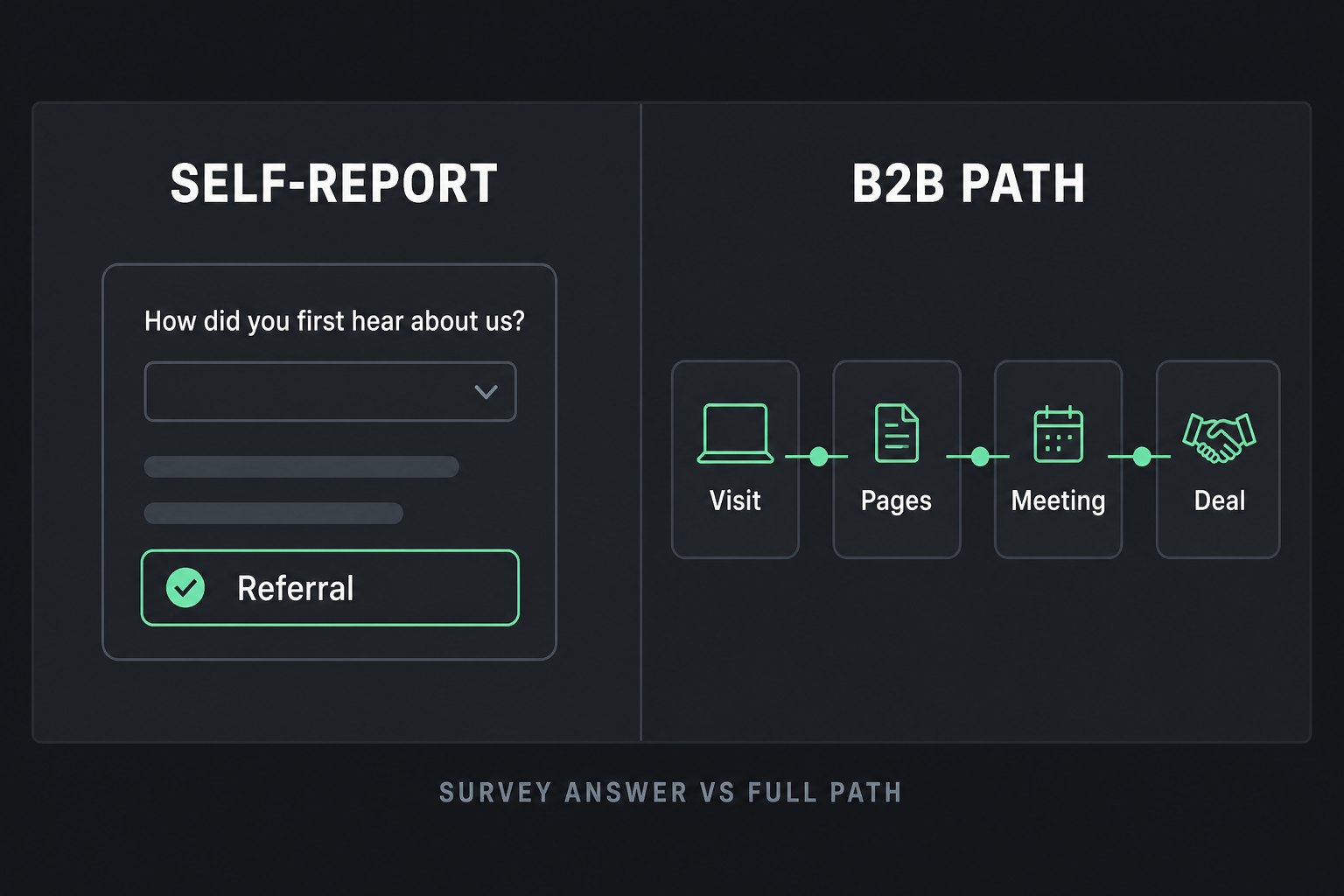
Self-reported attribution credits whatever a buyer picks on a form, usually “How did you hear about us?” B2B attribution keeps Visit, Pages, Meeting, and Deal on one path so CAC and channel quality stay honest. That is the real split when teams ask about self-reported attribution vs B2B attribution.
The survey answer is useful. It is still one memory at one moment. It does not replace the earlier paid visit, the later return from ChatGPT or another LLM, the calendar meeting, or the closed deal in the CRM.
We already covered CRM attribution vs B2B attribution and how to attribute ChatGPT and other LLM traffic. This piece sits next to those: a human-labeled channel versus the full Visit → Pages → Meeting → Deal path.
What does self-reported attribution actually record?
Self-reported attribution stores a buyer’s chosen answer. Common options look like Referral, Google, LinkedIn, Podcast, Event, or Other. Sales or marketing often writes that value onto a contact or company record in tools like HubSpot.
That field answers a real question: what does the buyer remember as the reason they showed up. It does not answer which ads they saw, which pages they read before the form, or whether a teammate booked the meeting weeks later.
Forms also freeze time. The answer is captured at signup or demo request. The deal may close months later after more visits, more stakeholders, and more channels. The dropdown never updates itself.
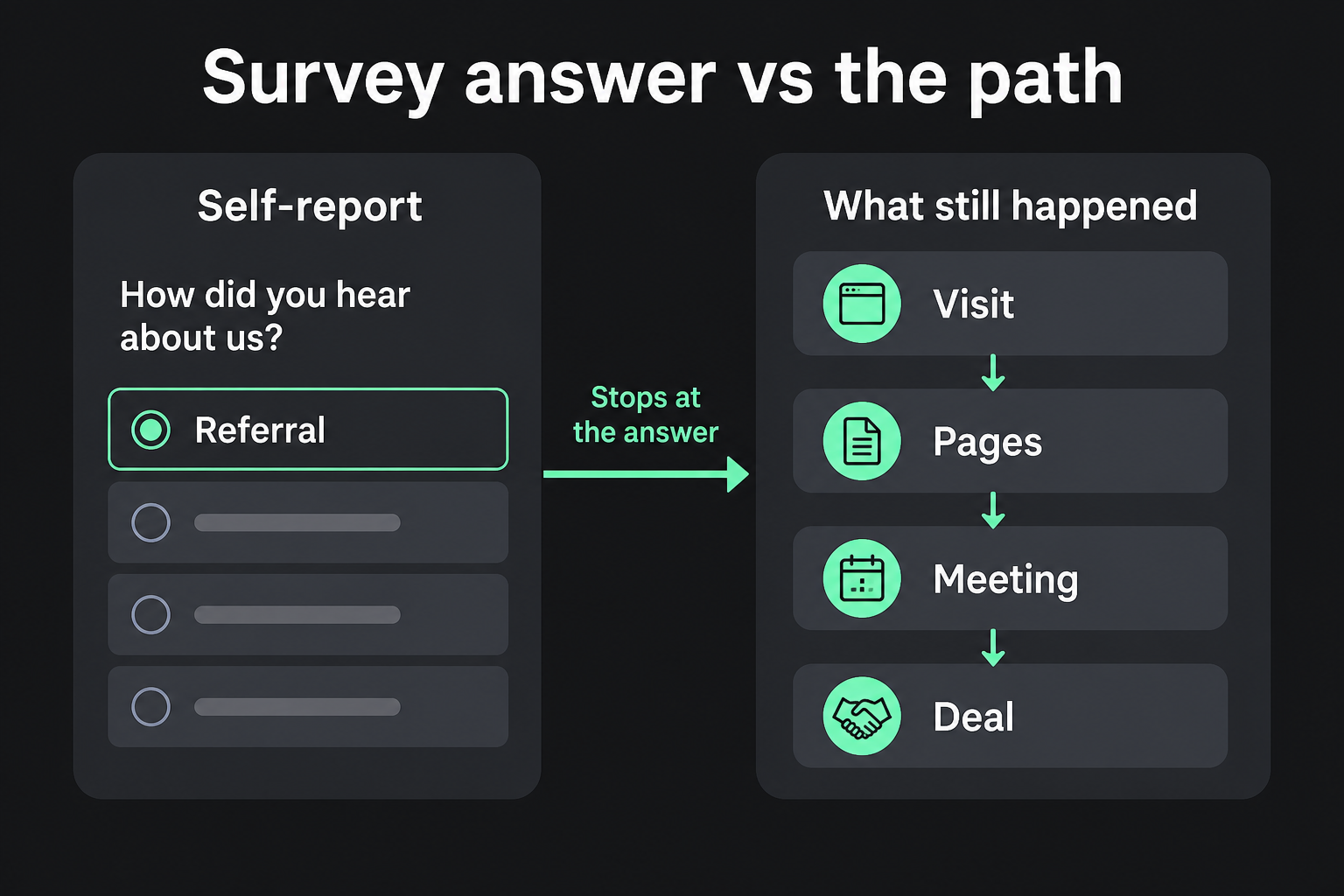
What does B2B attribution have to keep on the path?
B2B attribution has to keep the journey intact. A first Visit lands. Pages get read. A Meeting gets booked on a calendar. A Deal closes in the CRM. Credit models can weight those steps differently, but the underlying events have to stay connected.
That is the same spine we described in what B2B attribution actually has to connect and in what offline attribution means in B2B. Self-report is one input on that path. It is not the path.
When the path is complete, you can still read the survey field as a note. You just do not let it erase paid clicks, view-through exposure, or LLM referrals that never appear in the form options.

Where does a survey answer still help?
Keep the field. Ask it on demo forms and sales discovery. Use it to catch channels that leave weak cookies or no UTM string: podcasts, communities, dark social forwards, and in-person intros.
Self-report is strongest as a qualitative check. If many closed deals say Podcast and your path data never shows that show, you have a measurement gap. If path data shows paid LinkedIn and every survey says Referral, you have a memory bias, not a media result.
Sales teams also hear context the pixel will never capture: a founder intro at a dinner, a Slack mention inside another company, a board recommendation. Store those answers. Just do not treat them as the only ledger for spend.
Where does self-report break CAC and channel quality?
Problems show up when the survey answer becomes the only source of truth for spend decisions.
Buyers often name the last thing they remember, which rhymes with last-touch attribution even when the form never says that. They skip early paid clicks. They collapse LLM research into Direct or Other. They forget a teammate who clicked the original ad.
If you divide ad spend by self-reported counts alone, CAC moves with memory, not with revenue path. Channel quality then rewards the label that is easiest to pick on a form.
You also get category noise. “Google” can mean paid search, organic search, or a vague memory of a browser tab. “Referral” can mean a customer intro, an affiliate, or a friend who forwarded a LinkedIn post. Path data keeps those apart when the form cannot.
How should teams use both without double-counting?
Store the survey answer on the contact. Keep Visit, Pages, Meeting, and Deal on the same journey in your attribution stack. Report them side by side.
When the survey and the path agree, you get a clean story. When they disagree, investigate before you reallocate budget. Do not overwrite path credit with a single dropdown.
A simple operating rule: use self-report to explain narrative gaps, use path data to set CAC and channel quality, and use both in pipeline reviews so marketing and sales share one picture.
Source is built for that path view: one pixel and GTM, CRM and calendar joins, multi-touch and offline steps, plus LLM referrals that usually never match a survey option. You can still chat with the data and ask which channels actually sit on closed deals.
A practical check before you trust the field
For the last twenty closed deals, pull the self-reported answer and the credited path. Count how often they match. Note every deal where the survey says Referral or Other while the path shows paid, LLM, or Direct return traffic.
That sample is enough to decide whether the field is a helpful note or a broken budget dial. Most B2B teams need both: the buyer’s words, and the Visit → Pages → Meeting → Deal record.
If you want that path without a warehouse project, start free at dash.source.app/signup.