


What offline attribution means in B2B

Offline attribution keeps meetings, CRM deals, and calendar events on the same path as website visits. In B2B, that is how revenue reports stop starting after the call.
Most teams already track the site well. The pixel fires. Sessions land. Forms submit. Then a prospect books on Calendly or Google Calendar, the meeting happens, and the deal moves in HubSpot. Those steps never join the visit. The weekly report looks clean and still misses the work that closed the deal.
We already covered what B2B attribution has to connect, where marketing attribution stops, and multi-touch versus single-touch. This piece is the product pillar those posts assume: offline attribution.
What counts as an offline event in B2B?
In B2B, offline usually means activity that never fires your website pixel. A booked meeting. A live call. A stage change in the CRM. A closed-won deal. A calendar hold that turns into a demo. The buyer still came from an online path. The event itself lives outside the page. A podcast air date belongs here too, and our guide to podcast attribution for B2B shows how to log each episode as an offline touch.
That is different from a page view or a form fill. Those sit on the site. Offline events sit in tools that sales and ops already trust: calendars, CRMs, and deal pipelines. If attribution stops at the last site hit, you are measuring marketing activity and calling it revenue influence.
Offline does not mean mysterious. It means the event has a time, an owner, and a record that is not a pageview. CRM attribution only works when those records join the same journey as the visits that came before them.
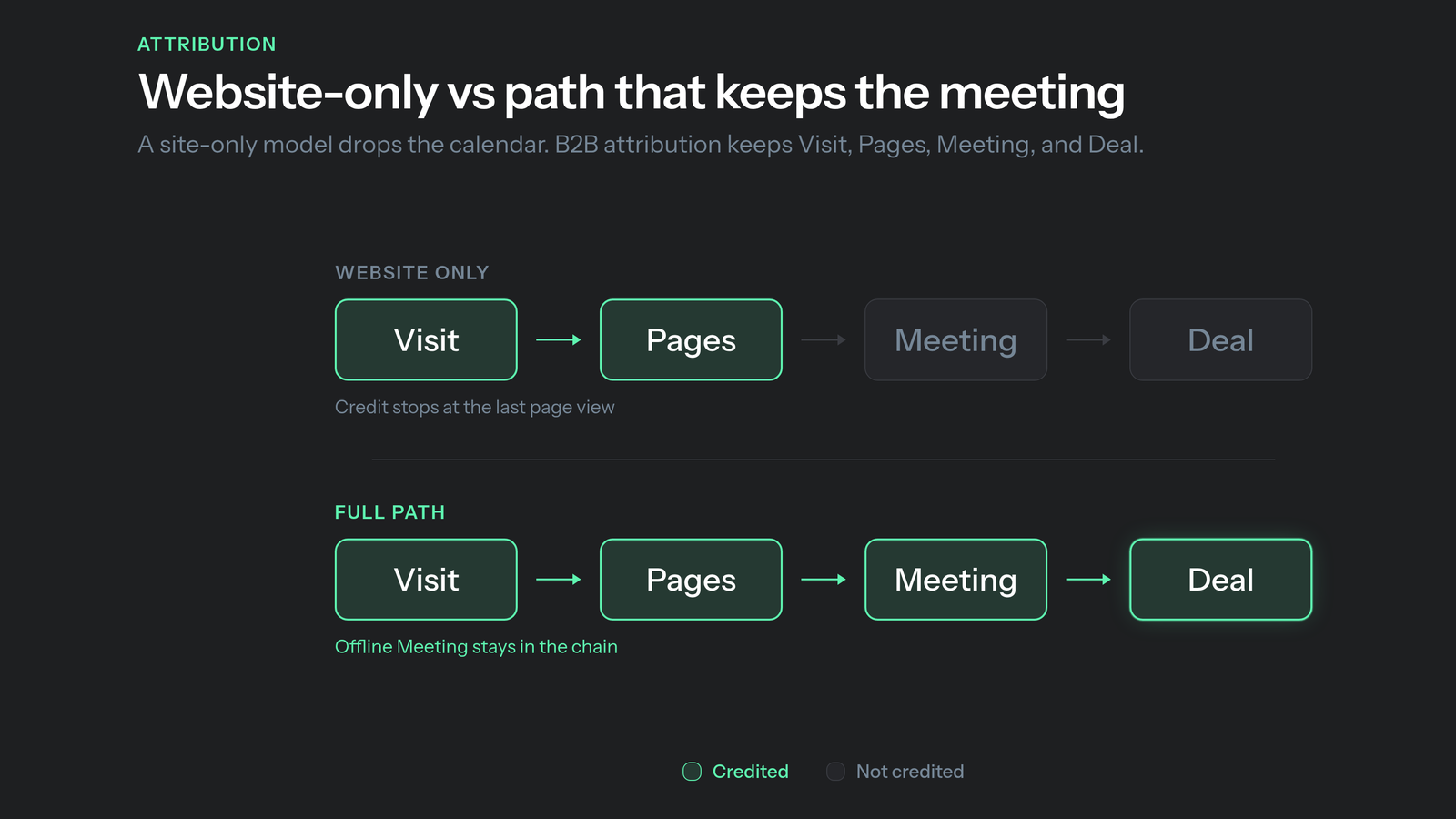
Why do website-only reports drop the meeting?
Website-only stacks are built for sessions. GA4 and ad platforms see clicks and pageviews. They do not automatically own the calendar invite or the CRM opportunity. When the meeting happens offline, the report has nowhere to put it.
So the path truncates. Visit and pages stay. Meeting and deal fall off. Multi-touch and single-touch then fight over incomplete data. Credit models cannot fix a missing event. They can only redistribute what you stored.
That is why CAC looks soft. Spend sits in Google Ads. Pipeline sits in HubSpot. The meeting sits in the calendar. Without a join, real CAC becomes a spreadsheet guess instead of a path-level number. Channel quality suffers the same way: a channel that creates meetings looks weak if you only count last-click form fills.
How does offline attribution differ from online attribution?
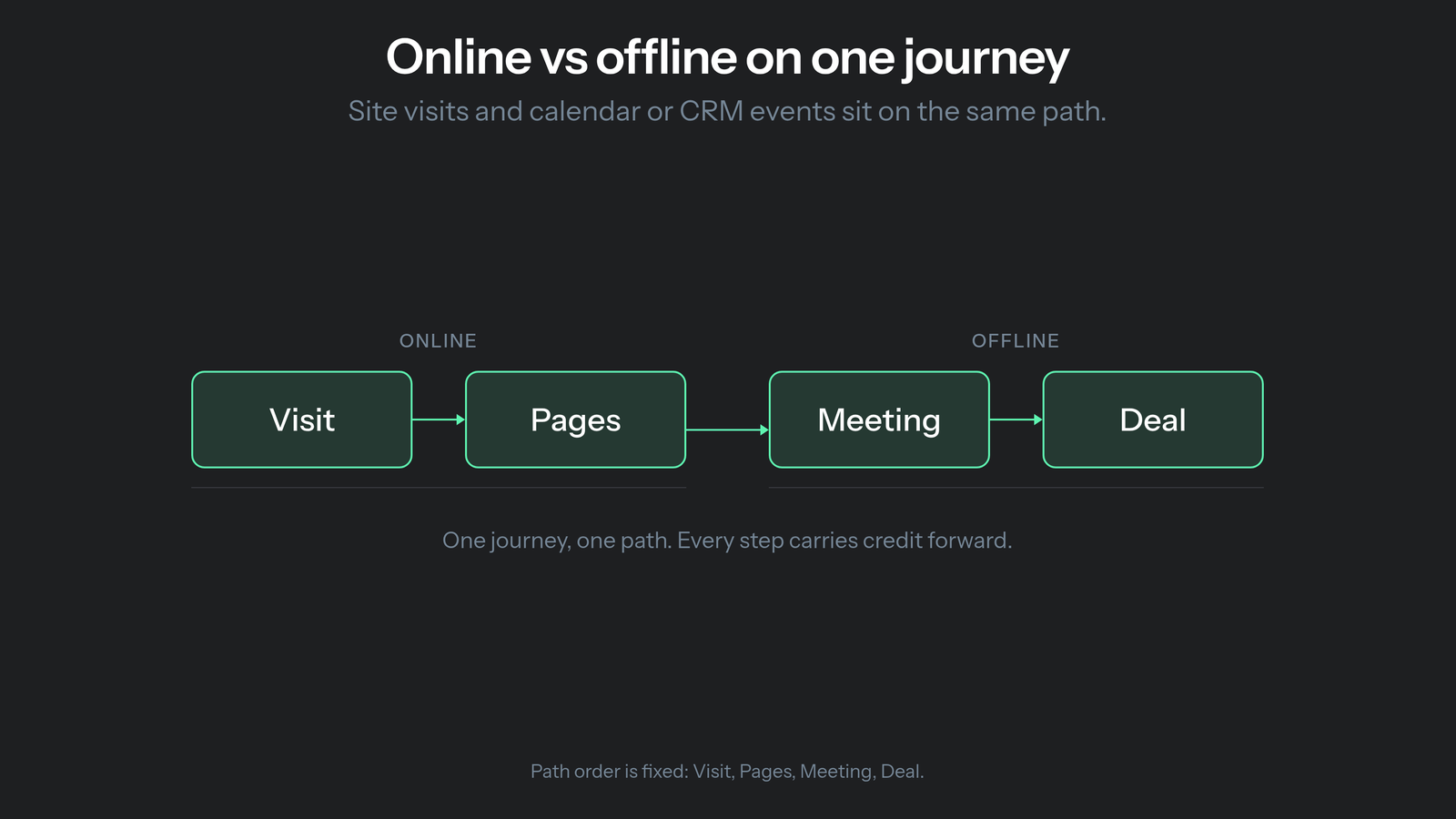
Online attribution covers what the pixel can see: visits, pages, forms, and some click-based conversions. Offline attribution extends that same journey through calendar and CRM events so the meeting and the deal stay attached to the earlier visits.
The difference is not a new philosophy. It is a longer path. Online-only ends where the site ends. Offline keeps going until revenue does. That is why teams that only look at site conversions undercount sales-assisted work and overcredit the last web event.
View-through and LLM traffic still matter here. An ad impression or a ChatGPT citation can start a path that only finishes in a booked call. If you never store the offline finish, those starts look wasted. We covered the adjacent cases in view-through attribution and LLM attribution.
Where do CRM deals, calendars, and CAC fit?
Calendars mark when the conversation happened. CRM deals mark what money moved. Attribution needs both on the same account journey as the site visits. That is CRM attribution in practice: not a separate report, but the same path with offline seats filled in.
Real CAC needs that join. Cost without meetings is a media metric. Meetings without visits are a sales metric. Closed deals without either are a finance metric. Offline attribution is the stitch that lets CAC, goals, and channel quality share one story.
You do not need a warehouse to do it. One pixel on the site, plus the GTM tools you already run, is enough to connect visits to meetings and deals. Then you can chat with the data, get an AI recommendation, and receive a daily report in Slack.
A check you can run this week
Pick five closed-won deals from the last 90 days. For each one, list the first known visit, the pages you can find, the calendar meeting, and the CRM stage that closed. Mark which of those events appear in your current attribution report.
If the meeting or the deal is missing, your model is online-only no matter what it is named. If the visit is missing, the CRM source field is carrying the whole story. Either way, the path is incomplete.
Source is built to close that gap. Drop in one pixel and it connects across the tools you already use. Multi-touch, view-through, offline activity, and LLM attribution for ChatGPT, Claude, Perplexity, and Gemini sit on the same path as a real CAC, a goal, and a read on channel quality.
Customer data is not used to train external models. Source is SOC 2 Type II and ISO 27001 certified.
If you want meetings and CRM deals on the same visit-to-deal path, start at Source. Attribution is broken. So we rebuilt it.
Install the pixel and connect your first data source in minutes. Start your free trial