


UTM tags are a label, not an attribution model

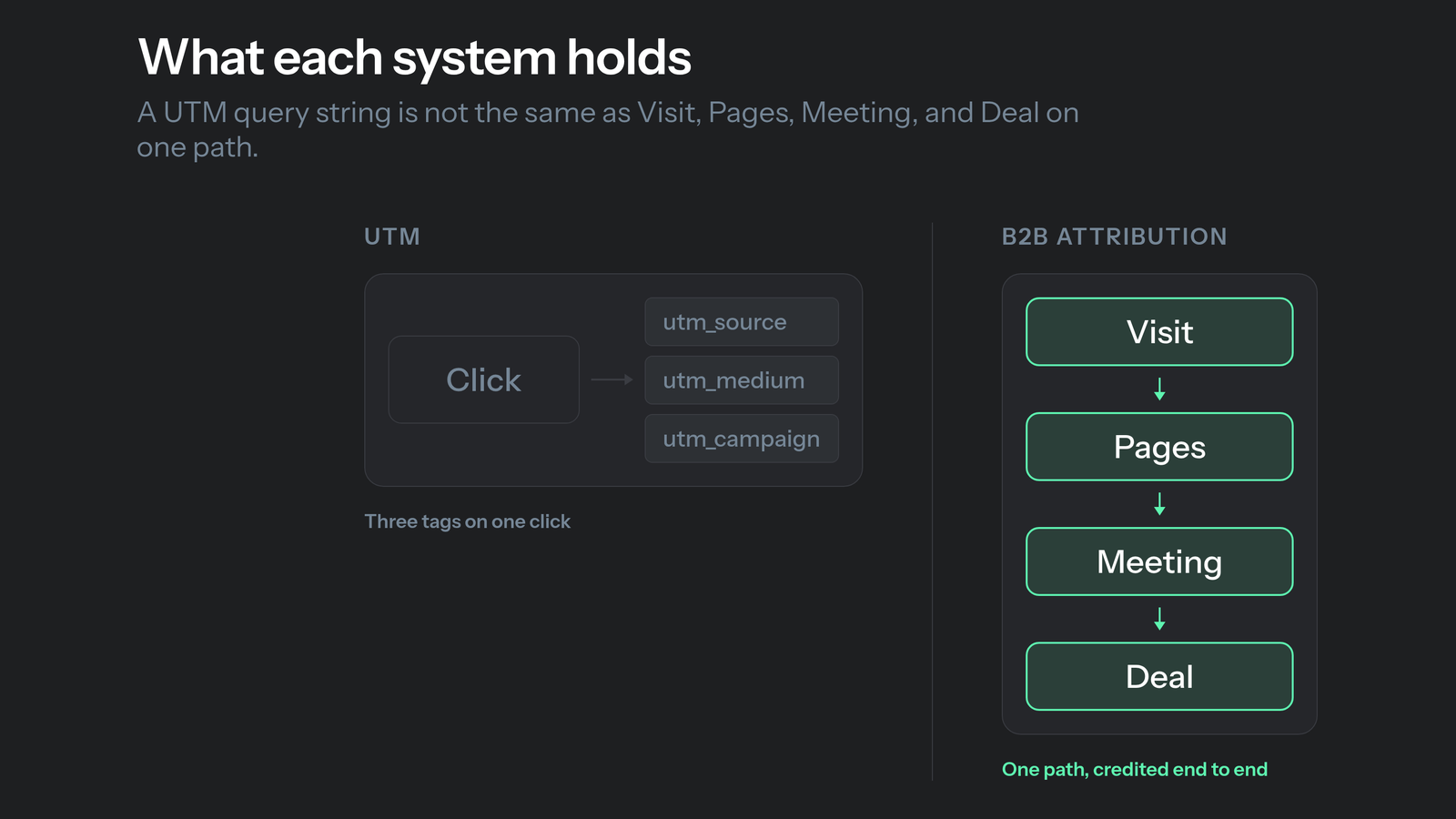
UTM tracking tags the campaign click that opened a page. B2B attribution keeps Visit → Pages → Meeting → Deal on one account path. That is the real split when marketers ask about UTM tracking vs B2B attribution.
Campaign URL parameters (UTMs) are how most B2B teams label paid, email, and partner links. They are useful. They are also incomplete when the question is revenue. A tag can tell you which ad or newsletter started a session. It cannot, by itself, keep the calendar booking, the CRM stage change, or a later Direct or LLM return on the same journey.
We already covered GA4 vs B2B attribution and what B2B attribution has to connect. For deal records versus the same path, see CRM attribution vs B2B attribution. This piece sits next to those: campaign tags versus the full Visit → Pages → Meeting → Deal path.
What do UTM parameters actually record?
UTM parameters are query string fields you append to a destination URL. Google's campaign URL docs list the core set: utm_source, utm_medium, and utm_campaign, plus optional fields like utm_term, utm_content, and utm_id. Analytics products read those values when the tagged link is opened and attach them to that session or hit.
In practice, a tagged Google Ads link or newsletter CTA tells Google Analytics which source, medium, and campaign sent the visitor. That is campaign labeling. It is not a closed-loop model of how that visitor became a meeting or a deal weeks later.
Where does UTM tracking stop in a B2B path?
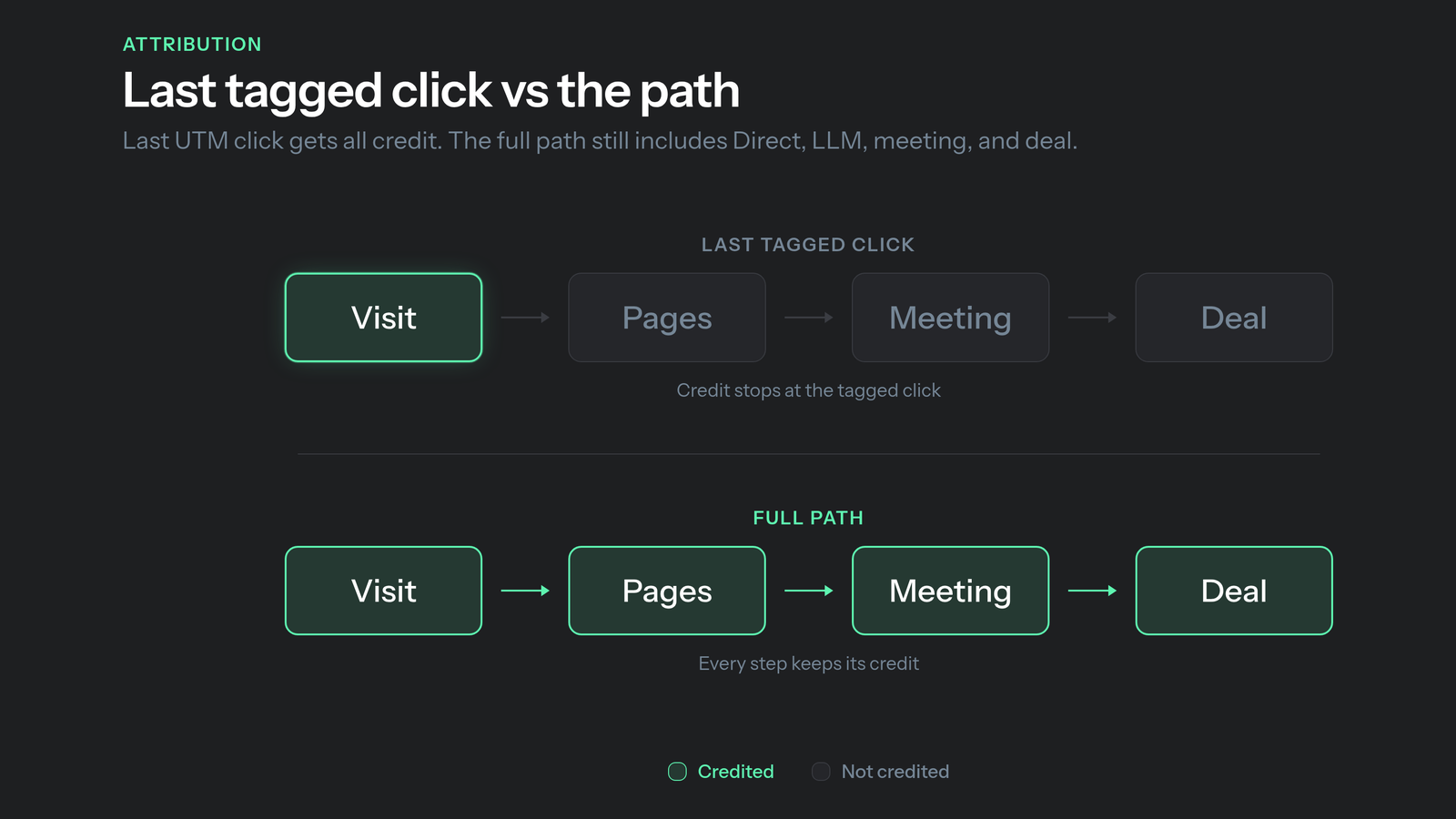
UTM credit stops at the tagged click and whatever on-site conversion you wire to that session. The meeting booked in Calendly is not a UTM field. The opportunity that moves in HubSpot is not a UTM field. A return visit that arrives without tags often lands as Direct.
That last gap matters more every quarter. Referrals from ChatGPT, Claude, Perplexity, or Gemini frequently arrive without a clean campaign string. If your model only trusts the last tagged click, those returns fall out of the story, and last-click credit sticks to whatever paid or email link still had parameters. We covered that failure mode in LLM attribution for ChatGPT traffic.
So UTM tracking answers: which tagged link opened this session. It does not answer: which channels created the meeting and the closed deal.
Teams feel this when CAC looks cheap in the ad platform and expensive in finance. The ad report is counting tagged clicks and on-site conversions. Finance is counting closed revenue. Without a shared path, both numbers are true and neither answers the board question.
How is B2B attribution different from campaign tags?
B2B attribution keeps the account journey intact: Visit → Pages → Meeting → Deal. Campaign tags can sit on the visit. They are one input. The path still has to hold multi-touch sequences, view-through starts, offline meetings, and CRM outcomes. First-touch and last-touch debates only make sense after that path exists. See first-touch vs last-touch and multi-touch vs single-touch.
Campaign tags alone produce tidy source reports. B2B attribution produces channel quality and real CAC, because the cost sits next to meetings and revenue, not next to a form fill that never became a call.
Put differently: UTMs are labels on doors. B2B attribution is the map of rooms the buyer actually walked through, including the ones that never had a sticker on the handle. Direct and LLM returns are those unmarked doors. If you drop them, you over-credit the last tagged campaign and under-credit the work that brought the buyer back.
When do you still need UTMs?
You still need UTMs on outbound links you control: paid creatives, email CTAs, partner placements, and event follow-ups. Clean naming keeps campaign reporting readable. Inconsistent tags create (not set) noise that no attribution product can invent away. Our list of UTM mistakes that send B2B deals to Direct covers the naming, redirect, and CRM field problems to check first.
You need B2B attribution when leadership asks which visits become pipeline. Tags help label the entry. The path has to keep calendar and CRM seats filled, including returns that never carried a UTM. Run both. Do not ask a query string to stand in for revenue attribution.
A practical rule: keep UTMs on every link you publish, then refuse to treat the last tagged click as the full story. When a deal closes, the path should still show the earlier tagged visit, the content sessions, the untagged return, the meeting, and the CRM outcome in one place. That is how channel quality becomes something you can defend, not a slide that falls apart under one finance question.
What does a working setup look like?
Keep tagging disciplined on every link you own. Then connect the site to ads, CRM, calendars, and Search Console through one pixel and the GTM stack you already run. No warehouse is required to start. Multi-touch, view-through, offline meetings and deals, and LLM attribution sit on the same journey so you can chat with the data, get AI recommendations, and receive a daily report in Slack.
Source is built that way. Real CAC, goals, and channel quality come from the path, not from exporting UTM reports into a spreadsheet after the call. Customer data is not used to train external models. Source is SOC 2 Type II and ISO 27001 certified.
If you want campaign tags for the click and a path that still reaches the deal, start at Source. Attribution is broken. So we rebuilt it.
Install the pixel and connect your first data source in minutes. Start your free trial