


PLG attribution, worked through one account from signup to paid
PLG attribution connects the marketing touches before a free signup to the moment that account starts paying. In a product-led funnel, the signup is the middle of the story, not the end. To attribute it well, track four milestones (signup, activation, team, and paid), keep every touch on one path per account, and credit the upgrade to the whole path instead of whichever click came last.
Most product-led teams stop at the signup. Ad platforms report signups, the CRM records a Contact, and the upgrade weeks later shows up as a Stripe invoice with no channel on it. This post walks through one account from first visit to first invoice, then shows how to set up the tracking and the report.
What is PLG attribution?
In a sales-led funnel, attribution follows a lead to an opportunity and a closed-won deal. In a product-led funnel, the buyer skips the form and the sales call. They sign up, use the product, bring in teammates, and upgrade on their own.
That changes what you attribute. A free signup is cheap and plentiful, and many never use the product. The revenue event is the upgrade, and it can land weeks after the signup, often triggered by someone other than the person who signed up. PLG attribution keeps the touches before the signup and the milestones after it on the same account record, so revenue can be traced back to the channels that started it.
A worked example: one account from first visit to first invoice
Here is a realistic path for one account at a B2B software company with a free plan. The numbers are illustrative, but the shape is common.
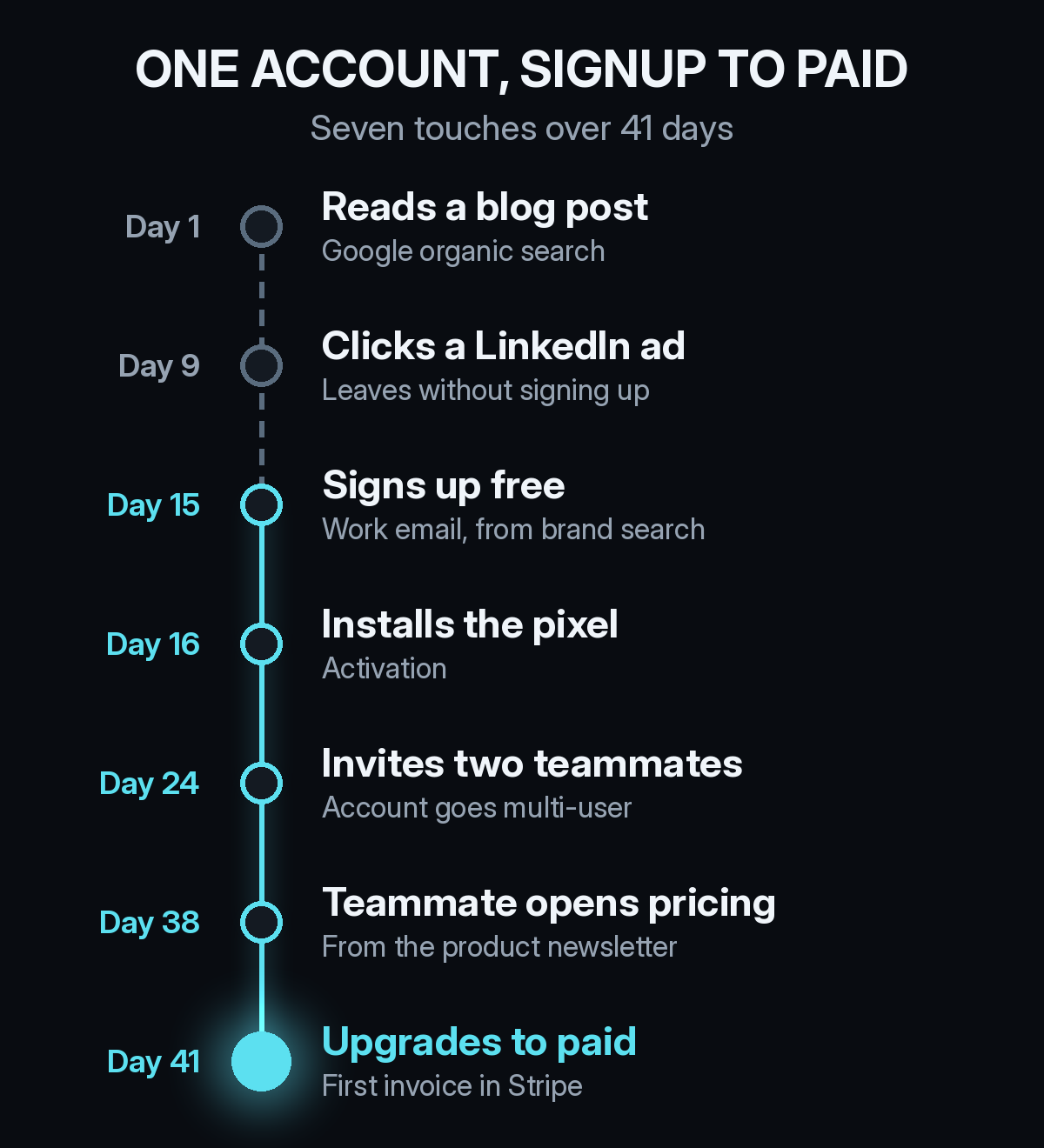
- Day 1. A marketer finds a blog post through organic search on Google.
- Day 9. She clicks a LinkedIn ad, reads the homepage, and leaves.
- Day 15. She searches the brand name, clicks a Google Ads brand ad, and signs up free with her work email.
- Day 16. She installs the product, which is the activation step for this company.
- Day 24. She invites two teammates.
- Day 38. One teammate opens the pricing page from a link in the product newsletter.
- Day 41. That teammate upgrades the account to a paid plan.
Ask three reports who earned this account and you get three answers. The ad platform credits brand search for the signup. The billing system credits nobody. A last-click view of the upgrade credits the newsletter. Each is true for one step, and none explains the revenue.
Two joins make the full path visible. The first is identity: the anonymous visits on day 1 and day 9 need to attach to the person who signed up on day 15, which we cover in how identity resolution connects anonymous visits to B2B pipeline. The second is the account: the teammate who upgraded is a different person, so both people have to roll up to one company record before the upgrade can inherit the earlier touches.
Which milestones should a PLG funnel attribute?
Track four milestones as separate conversions, each tied to the account.
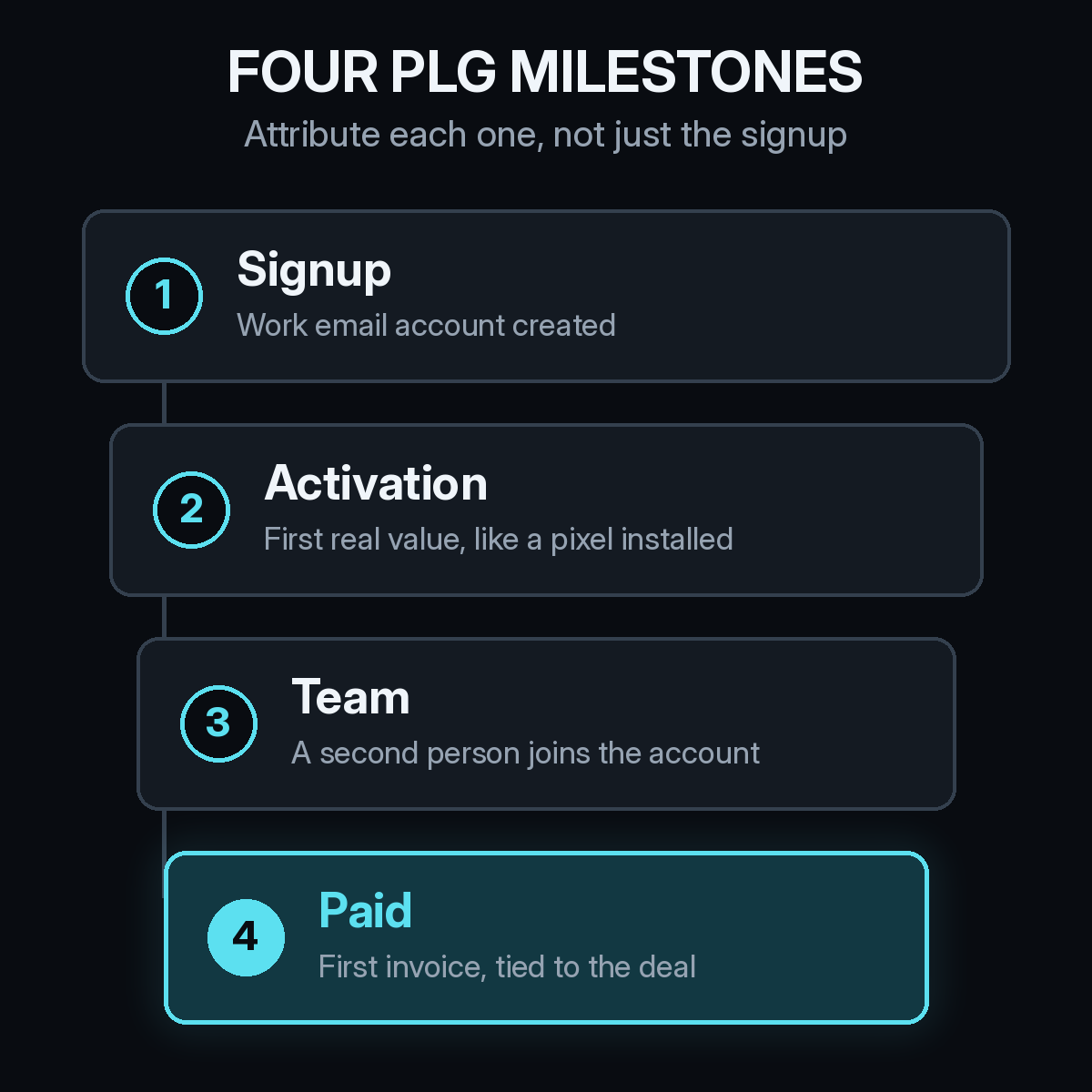
- Signup. A new account created with a work email. Personal addresses are worth tracking separately, since they rarely turn into team accounts.
- Activation. The first sign of real value. Pick one event that predicts paying, such as installing a tracking snippet, connecting an integration, or creating a first project.
- Team. A second person joins the account. In most B2B products, multi-user accounts upgrade far more often than solo ones.
- Paid. The first invoice, written back to the account and its deal in your CRM, such as HubSpot.
Each milestone answers a different question. Signups by channel tell you who is curious. Activations by channel tell you who fits. Paid accounts by channel tell you where revenue comes from. A channel that wins on signups and loses on activation is buying you the wrong people.
How does each model credit the upgrade?
Run the example account through three common models and the credit moves a lot.
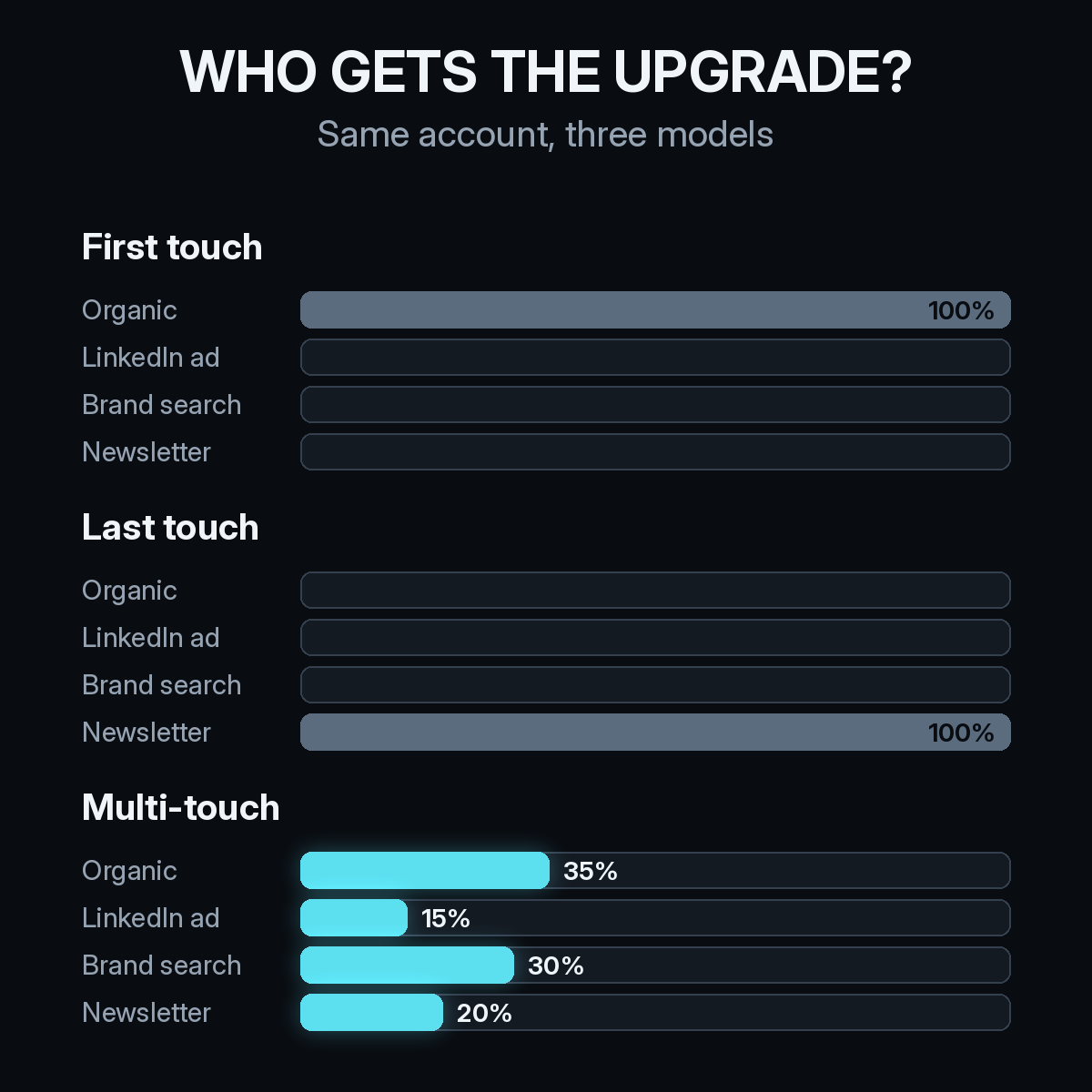
First touch gives all the credit to organic search, because the blog post came first. Last touch gives it all to the newsletter, because that link opened the pricing page. A multi-touch model that weights the first touch, the signup touch, and the upgrade touch more heavily splits it across all four, with the LinkedIn ad getting a smaller share for the visit in between. If you are still choosing a model, single-touch or multi-touch attribution: how to choose walks through the tradeoffs.
The lookback matters as much as the model. In this example, 41 days passed between the first visit and the invoice. A 30-day window would drop the blog post entirely. Our guide to the attribution window for long B2B sales cycles explains how to set one that covers your real time to upgrade.
What should you send back to the ad platforms?
Ad platforms optimize toward whatever conversion you give them. If that conversion is any signup, they will find cheap signups, including personal emails that never activate. Give them a deeper signal instead.
A good default is the work-email signup as the primary conversion, sent server-side so ad blockers do not drop it, with activation added once you have enough volume. Keep upgrades in your own reporting, since they arrive too late and too rarely for bidding to learn from. Our post on why cost per lead is the wrong first number for B2B paid ads covers the same idea for form-based funnels.
What belongs in the PLG attribution report?
Report by channel, at the account level:
- Signups, split into work and personal email.
- Activation rate, the share of signups that reach the activation event.
- Paid accounts and new revenue, credited across the full path.
- CAC per paid account, spend divided by accounts that upgraded, not by signups.
Read them together. A channel with a high cost per signup and a strong activation rate is often the cheapest source of revenue on the sheet.
How Source tracks PLG funnels
Source installs with one pixel or Google Tag Manager, with no data warehouse to build. It records every visit's UTMs and referrers, keeps a buyer's earlier anonymous visits once they sign up, and ties the full multi-touch path to Contacts and Deals in your CRM. Signups, activation events, and upgrades sit on that same path, along with view-through, offline, and LLM attribution for ChatGPT, Claude, Perplexity, and Gemini.
You get real CAC by channel, goals, and channel quality in one place, so you can judge spend on paid accounts instead of signups. You can chat with your data, read AI recommendations, and get daily Slack reports. Source is SOC 2 Type II and ISO 27001 certified, and customer data is not used to train external models.
Start free at dash.source.app/signup and see which channels your paying accounts came from.