


How to put marketing attribution on the board slide

Putting marketing attribution on a board slide means showing Visit to Deal in one line, real CAC, and pipeline by channel, including Direct and dark social. Boards do not need a 40-slide deck. They need a path that still makes sense when someone asks where pipeline came from last quarter.
This playbook is for marketers and CROs who already have CRM stages and channel reporting, and who keep getting stuck when Direct, podcasts, Slack shares, or LLM referral show up as noise. The goal is one honest page the board can read in under two minutes.
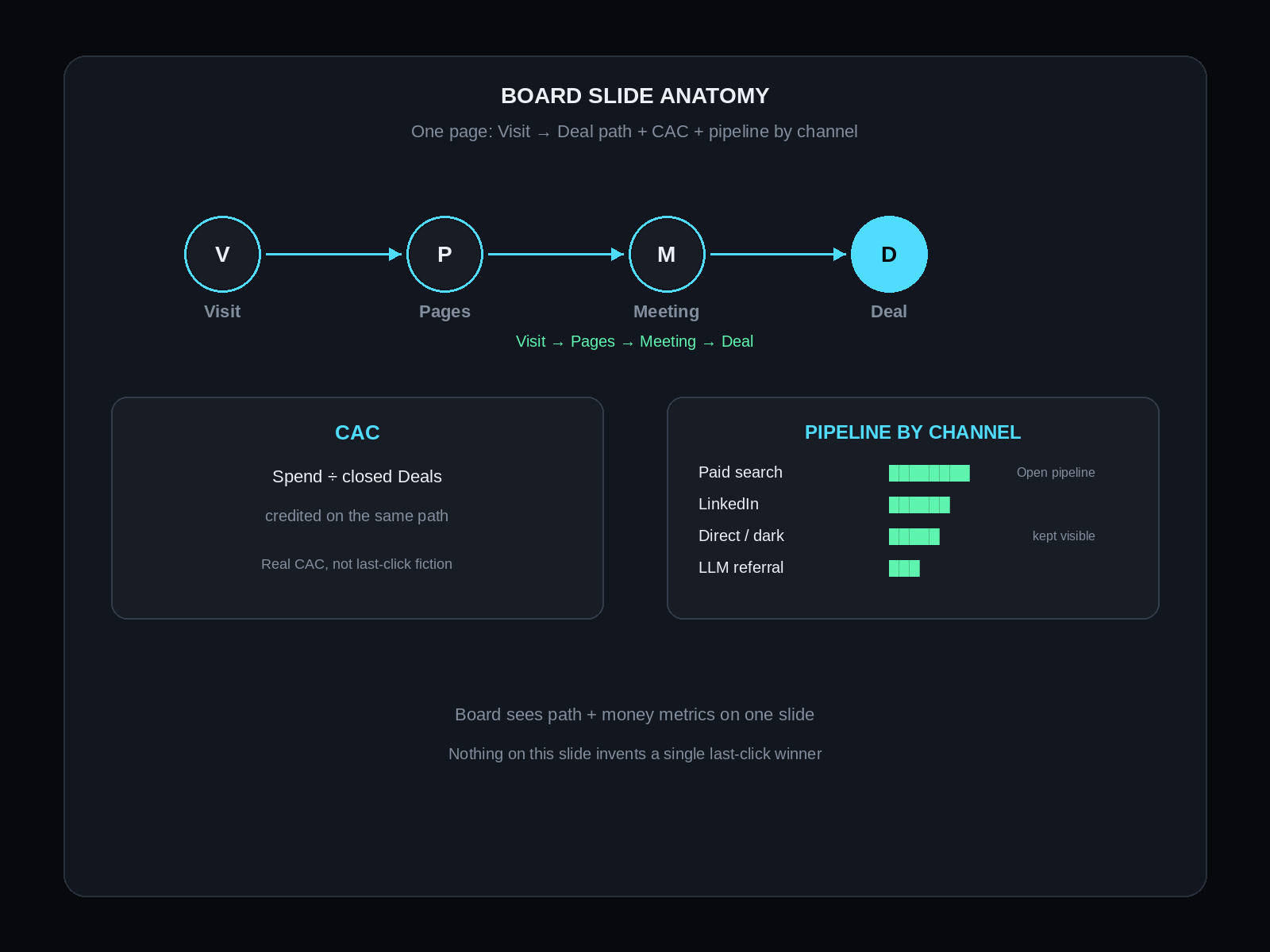
What belongs on a one-page board attribution slide
Keep three blocks. First, the Visit to Deal path for the reporting window. Second, CAC computed from the same path, not from a separate last-click export. Third, open and closed pipeline by channel, with Direct, dark social, and LLM referral kept visible instead of zeroed out.
That is enough for most board discussions. Add a short note on data freshness and which CRM stages map to Meeting and Deal. Skip vanity traffic charts, model bake-offs, and channel logos that do not change the decision.
If a metric does not help answer "which channels are creating Deals we can defend," leave it off. The slide is a summary, not a warehouse dump.
The Visit to Deal path in one line
Board audiences follow one sequence: Visit, Pages, Meeting, Deal. Visit is the first known session. Pages are the product and content touches that followed. Meeting is the booked sales conversation. Deal is the opportunity that closed or is still open.
Say the sequence out loud once on the slide. Then show counts for the period next to each stage. When the board asks why Meetings rose while Deals stayed flat, you already have the path in front of them instead of a channel ledger that only starts at form fill.
For a deeper look at what has to connect for that path to stay intact, see what B2B attribution has to connect.
CAC and pipeline by channel without double-counting
CAC on the board slide should be spend divided by closed Deals credited on the same Visit to Deal path. Do not mix a paid-media last-click CAC with a multi-touch pipeline chart. Directors notice when the denominator changes mid-conversation. For how to build that number channel by channel when Deals close months after the spend, see how to read CAC by channel when B2B deals take months.
Pipeline by channel is the companion block. Show open pipeline and closed-won dollars or Deal counts per channel. Use one attribution rule for both CAC and pipeline so Paid search, LinkedIn, Direct, and LLM referral sit in the same frame.
When a Deal touched three channels, credit the path you agreed with Finance. Multi-touch and view-through can live in the system. The board slide still needs one rule stated in a footnote, not three competing winner columns.
HubSpot and similar CRMs already hold the Deal stages. Attribution work is joining those stages to Visits and spend, not replacing the CRM.
What to do with Direct, dark social, and LLM referral
Direct and dark social are where a lot of B2B pipeline hides. A buyer hears about you on a podcast, in Slack, or from a peer, then types the URL. Analytics call that Direct. The board slide should keep the bucket visible and sized, not pretend those Deals came from the last ad click.
LLM referral is the same honesty test. ChatGPT and similar tools send sessions that look thin in classic channel reports. Put them on the path when you can resolve them, and keep an explicit line when you cannot. For more on that traffic, see LLM attribution and ChatGPT traffic.
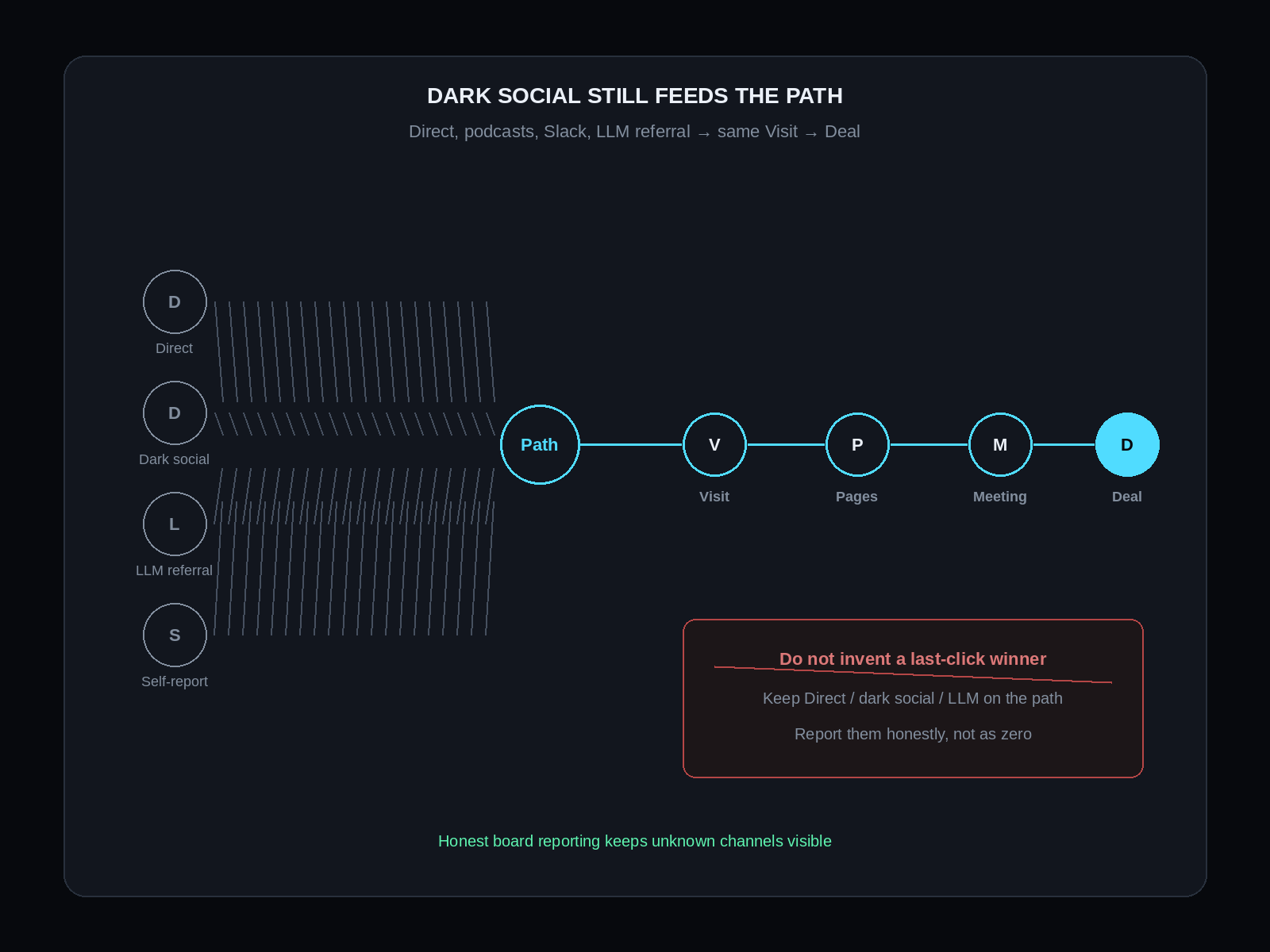
Self-reported answers help when the click path is blank. Ask how they heard about you, capture it on the contact or Deal, and join it back to the Visit to Deal path. Dark social attribution that never reconnects to revenue is just a survey. Connected to Deals, it becomes board-safe. How to find the deals hiding in Direct traffic covers that join in more detail.
What to leave off the slide
Leave off last-click winner charts that erase Assist. Leave off model beauty contests. Leave off raw session dumps, pixel health screenshots, and warehouse architecture. Leave off every channel with under a handful of Deals unless Finance asked for the long tail.
Also leave off fake precision. If Direct is large, say so. If LLM referral is rising and still noisy, say the path is partial. Boards trust a clear unknown more than a made-up winner.
View-through and offline touches belong in the system that feeds the slide. They rarely need their own board graphic. Keep them in the path definition so CAC stays real when TV, events, or partner meetings matter. View-through attribution in B2B is useful background when someone asks why a paid impression still sits on the path.
How Source keeps the path together
Source ties Visit, Pages, Meeting, and Deal with one pixel and your GTM setup. No warehouse required. You can chat with the data, get AI recommendations, and send daily Slack reports. Multi-touch, view-through, offline, and LLM attribution stay on the same path so CAC is real.
Source is SOC 2 Type II and ISO 27001 certified. Customer data is not used to train external models. If you want the board slide to stop arguing with the CRM export, start a Source workspace or read more at source.app.