


Influenced pipeline: what it means and when to report it

Influenced pipeline is the total value of open and won opportunities where a marketing channel touched the account before the opportunity was created. It answers a different question than sourced pipeline. Sourced asks which channel started the deal. Influenced asks which channels showed up along the way. Both are useful, and the influenced number only misleads when it is reported alone or added up across channels.
What does influenced pipeline mean?
Take one account. Someone at the company attends your webinar in March. Two colleagues read a blog post in April. In May, their head of ops asks ChatGPT for tools in your category and clicks through from the answer. Then an SDR emails them, and they book a meeting. An opportunity worth $40,000 is created.
In a sourced pipeline report, that $40,000 goes to one place, usually the first touch that started the account's path. Here that is the webinar. In an influenced pipeline report, the same $40,000 shows up under webinars, under content, and under AI search, because each one touched the account before the opportunity existed.

The SDR email counts too if you track outbound as its own channel. Many teams keep sales touches in a separate column so marketing and sales can each see their part, which helps when sales and marketing both claim the same deal.
How is influenced pipeline different from sourced pipeline?
Sourced pipeline gives each deal to exactly one channel. Add up every channel's sourced number and you get your total pipeline. That makes it the right number for budget math and for reading CAC by channel.
Influenced pipeline repeats each deal in every channel that touched it. Add up every channel's influenced number and you get a figure far larger than the pipeline you actually have. That is not a bug. It is the point of the metric. It shows reach across the buyer's path, not ownership of the deal.
A useful way to read the two together: sourced tells you where deals start, influenced tells you which channels keep accounts moving. A channel with low sourced pipeline and high influenced pipeline is often doing its job in the middle of the journey. Podcasts, review sites, and AI search answers tend to look like this.
When should you report influenced pipeline?
Report it when the question is about contribution. Is the content program reaching accounts that later buy? Do webinar attendees turn up in opportunities more often than people who never attend? Is AI search traffic from ChatGPT, Claude, Perplexity, and Gemini part of the path for real deals, or just curious visitors?
Avoid it when the question is about money. If a board member asks how much pipeline marketing created, give the sourced number and show influenced as context. If you are deciding where the next dollar goes, start from sourced pipeline and cost, then use influenced to spot channels a single-touch view undersells. Our guide to putting marketing attribution on the board slide shows how to lay out both without confusing the room.
How do you calculate influenced pipeline?
The math is simple once the data is connected. For each opportunity, list every touch on the account before the creation date. Group those touches by channel. For each channel, add the opportunity value once, no matter how many times that channel touched the account.
The hard part is the data. You need anonymous visits tied to the people who later fill a form, every person tied to their account, and the account tied to the opportunity in your CRM, such as HubSpot. Without that chain, most early touches never reach the report, and influenced pipeline looks smaller than it really is.
You also need a few rules written down before the first report goes out.
Which rules keep the number honest?
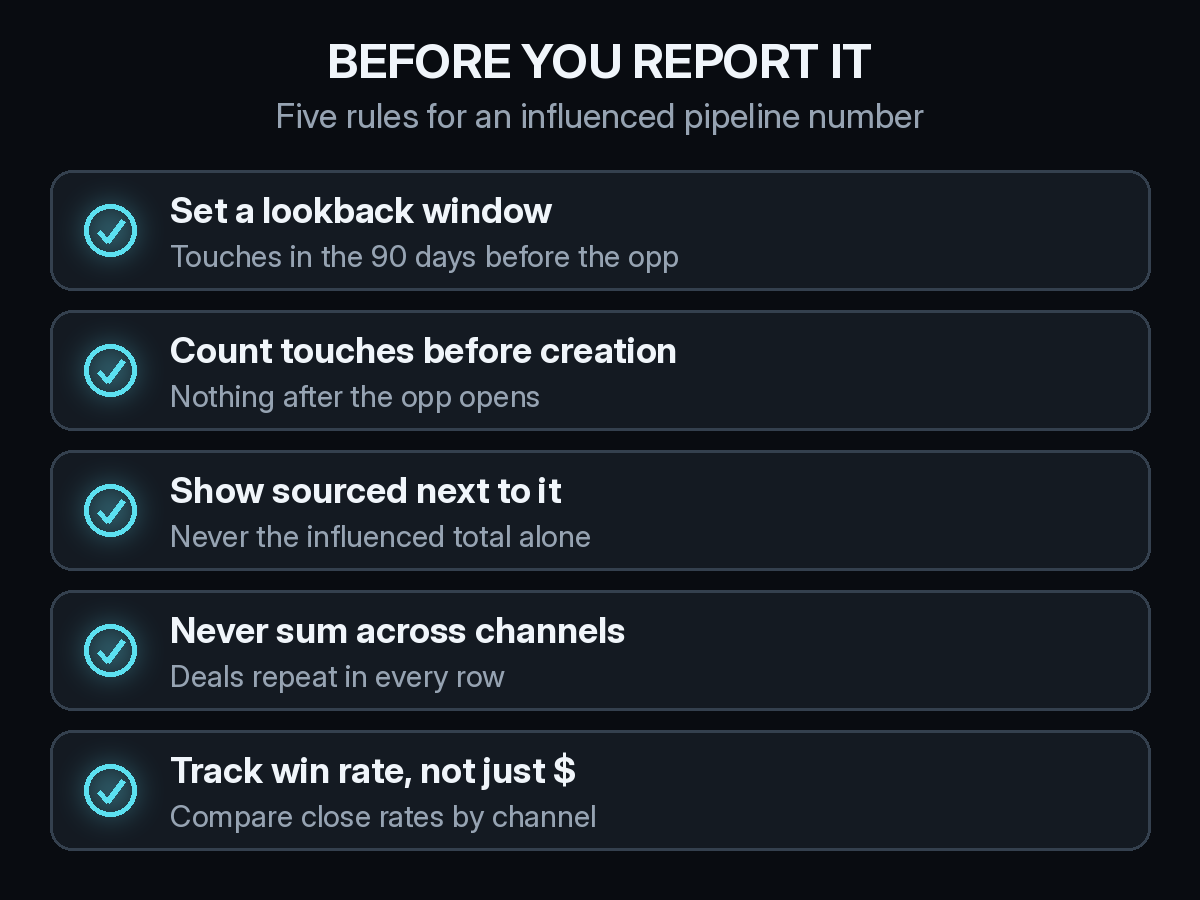
Set a lookback window. Decide how far back a touch can be and still count. Ninety days is a common starting point, but long cycles may need more. Our piece on the attribution window for long B2B sales cycles covers how to pick one.
Count only touches before the opportunity was created. Touches after that point belong to deal acceleration, which is a separate question. Mixing them inflates every channel that sales uses during the deal.
Show sourced next to it. An influenced figure alone invites someone to compare it to total pipeline and conclude marketing is responsible for three times the business. Put both columns side by side every time.
Never sum across channels. Each row is correct on its own. The total row is meaningless. Leave it off.
Track win rate, not just dollars. Influenced dollars grow with any channel that reaches a lot of accounts. Win rate on influenced deals tells you whether that reach matters. Compare close rates for accounts a channel touched with accounts it did not.
Where do view-through and AI search fit?
Influenced pipeline is where touches without clicks finally get counted. A buyer who saw your LinkedIn ad three times and never clicked still had a touch. View-through attribution records that impression so it can show up as influence on the account. The same goes for AI search. When ChatGPT or Perplexity recommends you, the visit often arrives with no UTM and lands in Direct. If you can identify that traffic, it belongs in the influenced view. Our explainer on attributing ChatGPT and other LLM traffic walks through how to spot it.
These touches rarely start a deal on their own, so a sourced report hides them. Influenced pipeline is often the first place they show their value.
How Source reports influenced pipeline
Source connects the full path with one pixel and Google Tag Manager, with no warehouse to build. It ties anonymous visits to people, people to accounts, and accounts to opportunities. Multi-touch, view-through, offline, and LLM attribution for ChatGPT, Claude, Perplexity, and Gemini all feed the same account path, so sourced and influenced pipeline come from one model instead of two spreadsheets.
From there you can see real CAC, goals, and channel quality, chat with the data to ask which channels show up most in won deals, get AI recommendations on where to shift spend, and read a daily Slack report. If you prefer a fuller model view, our practical checklist for multi-touch attribution pairs well with this one.
Source is SOC 2 Type II and ISO 27001 certified, and customer data is not used to train external models.
If your influenced pipeline number is a guess today, start free at dash.source.app/signup and see every touch that came before the opportunity.