


Multi-touch attribution, worked through one B2B deal

Multi-touch attribution (MTA) is a marketing measurement method that distributes conversion credit across the recorded online and offline touchpoints in a customer's journey, rather than giving all of it to the first or last interaction.
The easiest way to understand it is to take one B2B deal and run it through each model. The model only changes how credit is divided. Which touches get counted at all depends on what your tracking can see, and in B2B that matters more than the model you pick.
Below is one example deal, walked through touch by touch. It is a made-up path, but it is built from the kinds of touches B2B teams see every week.
What is multi-touch attribution?
Multi-touch attribution is a set of rules for dividing credit. You take every recorded touchpoint inside a lookback window, line them up in order, and give each one a share of the deal. The share depends on the model.
Single-touch models are the simple case. First touch gives everything to the touch that opened the relationship. Last touch gives everything to the one right before the conversion. Multi-touch models sit between those, and the common ones are linear, time decay, U-shaped (also called position-based), and W-shaped.
None of these rules is a measurement. Each one is a choice about what you believe mattered. That is fine, as long as everyone reading the report knows which choice was made.
What does a real B2B deal path look like?
Here is the example. A marketing lead at a software company sees a LinkedIn Ads campaign in her feed twice and never clicks. A week later she asks ChatGPT for attribution tools, gets an answer that names the company, and clicks through to the site.
She comes back to sign up for a webinar, which creates her as a lead in the CRM. After the webinar she reads a blog post she found through organic search. A few weeks later she searches the brand name on Google, clicks the Google Ads brand ad, and requests a demo. Sales takes it from there and the deal closes.

That is five marketing touches before the opportunity. The order matters, and so does the type of each touch. Two of them, the ad view and the AI answer, are the ones most setups record badly or not at all.
How does each model split credit on that deal?
Now run the same five touches through each model. These are the standard rule weights, not results from any account.
First touch gives all the credit to the LinkedIn ad. If your tracking only counts clicks, it gives it to the ChatGPT visit instead, because the ad view was never recorded.
Last touch gives all the credit to the branded search click and the demo request. This is what most ad platforms and many CRMs report by default, which is why brand search often looks like the best channel in the account.
Linear gives each of the five touches 20%. It is easy to explain and it never ignores anything it sees, but it treats a blog visit the same as the touch that created the lead.
U-shaped gives 40% to the first touch, 40% to the last, and splits the remaining 20% across the middle three. We went deeper on this one in our guide to position-based (U-shaped) attribution.
W-shaped gives 30% each to the first touch, the touch that created the lead (the webinar signup), and the touch that created the opportunity (the demo request), with the last 10% shared by the others. Our W-shaped attribution walkthrough covers when that milestone weighting fits.
| Model | How credit is split on this deal |
|---|---|
| First touch | 100% to the LinkedIn ad, or to the ChatGPT visit if the ad view was not recorded |
| Last touch | 100% to the branded search click and demo request |
| Linear | 20% to each of the five touches |
| U-shaped | 40% first, 40% last, and 20% split across the middle three |
| W-shaped | 30% first, 30% lead creation, 30% opportunity creation, 10% to the rest |
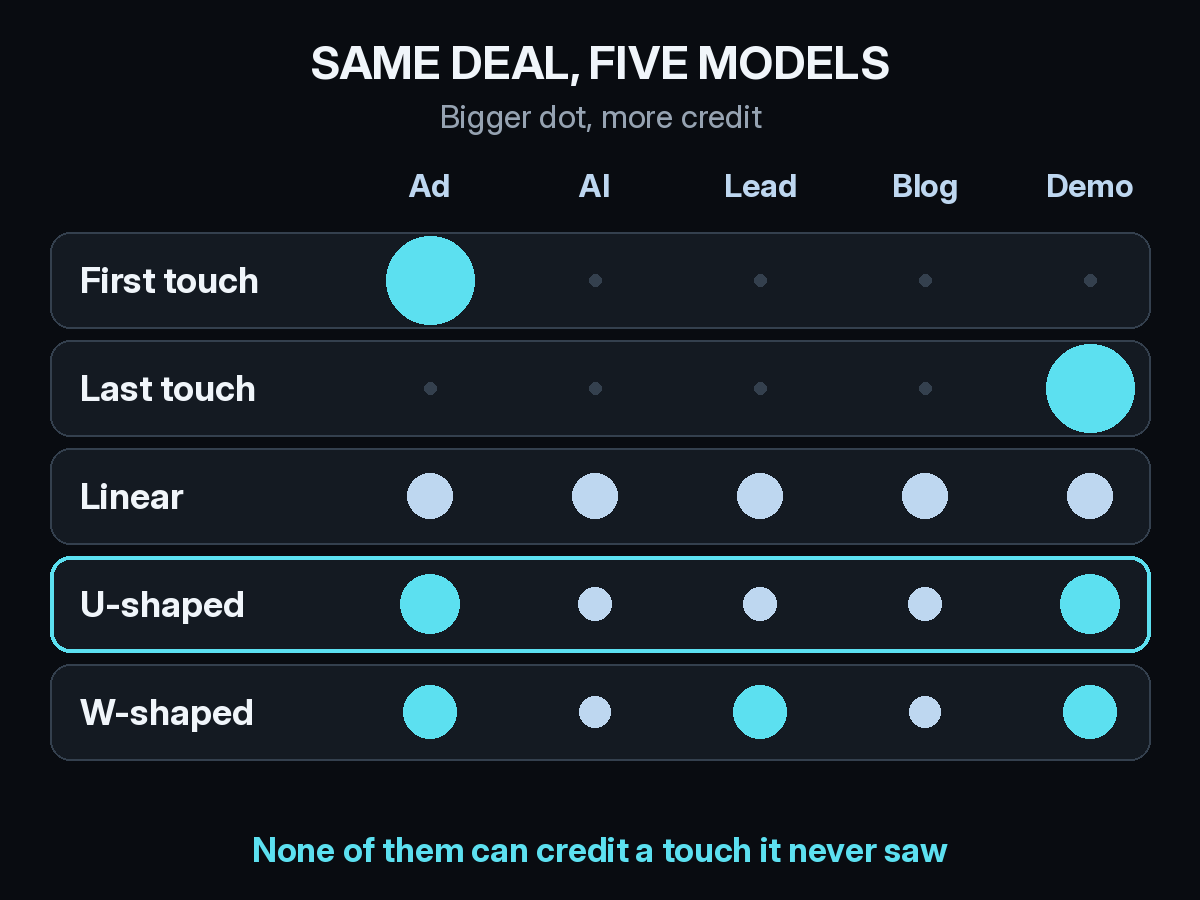
Notice what stays the same across all five rows. Every model is working from the same list of touches. If a touch is missing from that list, no model can give it credit.
Which touches does multi-touch attribution miss?
In this example, the touches at risk are the ones that started the deal.
The LinkedIn ad view had no click, so it only shows up if your attribution pulls in impressions and connects them to the person who later visited. That is view-through attribution, and we wrote about how view-through attribution works in B2B and how to keep the lookback window honest.
The ChatGPT visit often lands in Direct or Referral, because AI assistants do not always pass a clean referrer. If you cannot see visits from ChatGPT, Claude, Perplexity, and Gemini as their own channel, that touch either disappears or gets credited to something else. Our post on attributing ChatGPT and other LLM traffic walks through the mechanics.
The webinar is the third weak spot. Registration is usually tracked, but attendance and conversations happen outside the website. Bringing that offline activity into attribution is what lets the W-shaped model put credit on the right moment.
If you lose the ad view and the AI visit, the path shrinks to three touches and the webinar signup becomes the first touch. Every model then shifts credit away from the channels that found the buyer.
Which multi-touch model should a B2B team use?
Our view: pick one that matches how your deals are built, write it down, and stop switching. U-shaped is a sensible default when you care about how buyers find you and what gets them to a demo. W-shaped fits better when lead creation is a real milestone your team acts on. Linear is a good check when people suspect the ends of the path are getting too much.
Comparing two models side by side on the same deals is useful. Changing the model every quarter until a favorite channel wins is not.
Spend your effort on coverage first. Getting the ad view, the AI visit, and the webinar onto the path will change your numbers more than moving from U-shaped to W-shaped.
How does multi-touch attribution connect to CAC?
Credit only becomes useful when you put cost next to it. Once each closed deal has its credit split, you can add up the share each channel earned, compare it with what you spent on that channel, and get a CAC by channel built on revenue instead of leads.
In the example, last touch would make brand search look like it closed the deal for the price of one click. A model that sees the full path shows that LinkedIn and AI search did the early work. We covered how to set this up in our guide to CAC by channel in B2B.
How Source handles multi-touch attribution
Source was built to keep the whole path on one record. One pixel, or a tag in GTM, plus connections to the ad platforms and CRM you already use, with no warehouse to set up. Multi-touch, view-through, offline, and LLM attribution for ChatGPT, Claude, Perplexity, and Gemini all sit on the same deal path.
From there you can see real CAC, set goals, and judge channel quality. You can chat with your data, get AI recommendations, and receive a daily report in Slack. Source is SOC 2 Type II and ISO 27001 certified, and customer data is not used to train external models.
FAQ
What is multi-touch attribution?
Multi-touch attribution is a set of rules for dividing credit for a conversion or deal across every recorded touchpoint in a lookback window, instead of giving 100% to the first or last interaction.
How is it different from first-touch or last-touch attribution?
First touch gives everything to the interaction that opened the relationship. Last touch gives everything to the one right before the conversion. Multi-touch models sit between those and split the credit, using rules such as linear, time decay, U-shaped, or W-shaped.
Which multi-touch model should a B2B team use?
Pick one that matches how your deals are built, write it down, and stop switching. U-shaped is a sensible default when you care about how buyers find you and what gets them to a demo. W-shaped fits better when lead creation is a real milestone. Coverage of the path matters more than the model.
What does multi-touch attribution miss?
Any touch your tracking cannot see gets 0%. In B2B that is often an ad view with no click, a visit from ChatGPT or another AI assistant, and offline activity such as a webinar or a sales meeting.
If you want to see how your own deals split across touches, you can sign up for Source and run your recent closed deals through it, or learn more at source.app.