


Self-reported attribution checklist for B2B teams

Self-reported attribution is the answer a buyer gives when you ask how they found you, usually in a "How did you hear about us?" field on a demo or signup form. It records what the buyer remembers, and that memory often includes a podcast episode or a recommendation in a private Slack group that your tracking never saw. This checklist covers how to collect the answer so it is still usable a quarter from now, and where it belongs in your marketing attribution.
Whether the field deserves a spot on your form is its own question, covered in Should you trust "How did you hear about us?". Once you have decided to ask, the setup decides whether the answers turn into decisions or sit in a column nobody opens.
What goes on a self-reported attribution checklist?
Six steps cover most B2B teams. Each one closes a gap that tends to appear once the field has been live for a few months.
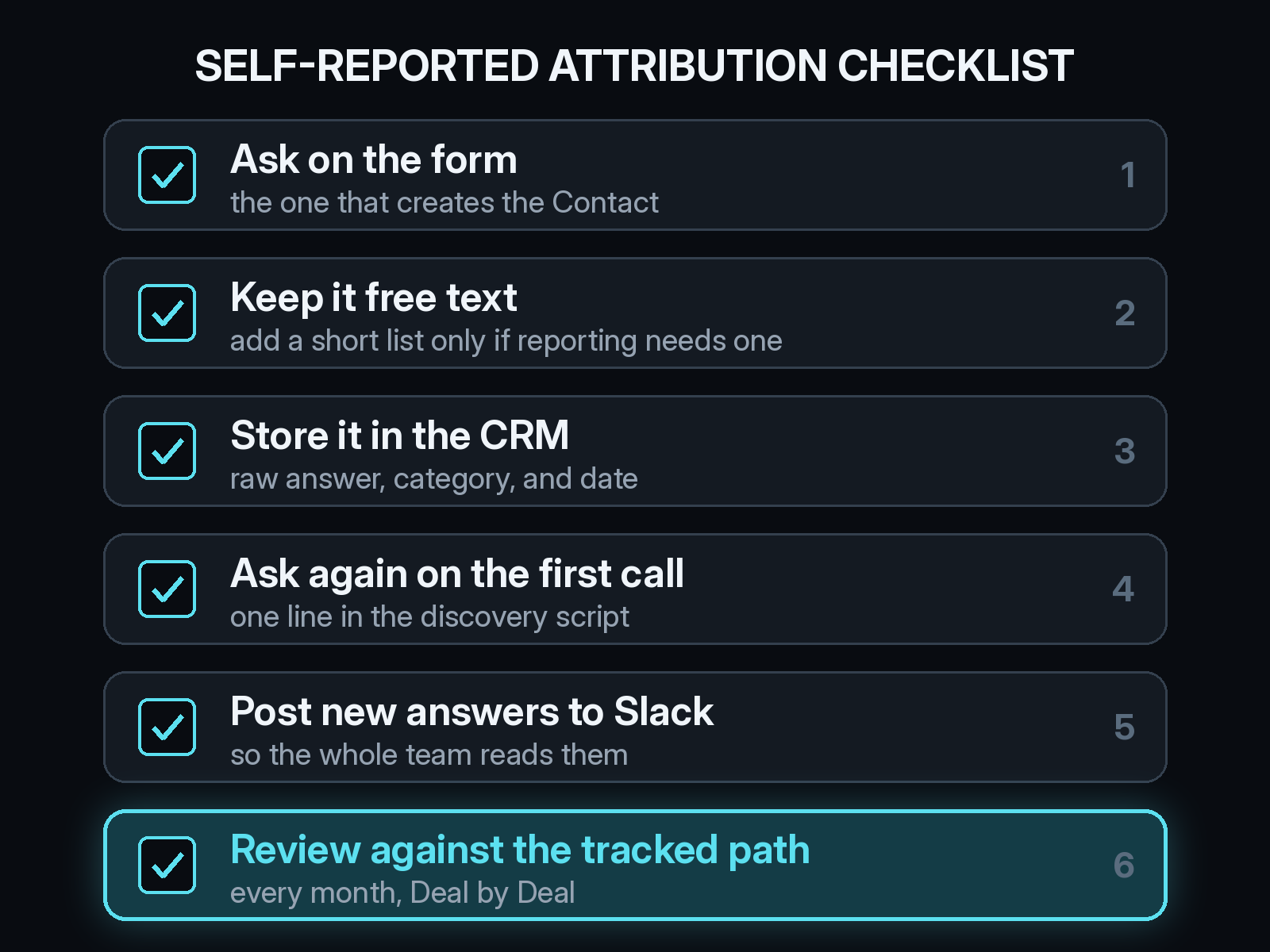
- Ask on the form that creates the Contact. Put the question on your demo request and signup forms. Make it required on demo requests, where the buyer has already decided to talk to you and one more field costs little.
- Keep it free text. A dropdown of your own channels gets your own channels back. A text box gets answers like "my CFO forwarded your pricing page" or "heard your founder on a podcast." If reporting needs a list, add a short dropdown with an "Other" option and keep the text box next to it.
- Store the raw answer, a category, and the date in the CRM. In HubSpot or Salesforce, create a text property for the raw answer and a separate dropdown property for the category, such as Peer, Podcast, Community, Social post, Newsletter, Search, AI assistant, Event, and Other. Keep that list stable. Never write the answer into Lead Source or Original Source, since those fields follow their own rules, which our post on why your Lead Source field is misleading you explains.
- Ask again on the first call. Add one line to the discovery script: "Before we start, how did you first come across us?" Buyers give fuller answers out loud, and sales hears names a form never captures, like the colleague who recommended you. Log the call answer in the same property with a note on where it came from.
- Post new answers to Slack. Route each new answer to a shared Slack channel. Reading them every day keeps the team close to the words buyers use, and new sources show up early, like a newsletter that mentioned you or a recommendation from ChatGPT.
- Review the answers against the tracked path every month. Pull every Deal created that month and put the self-reported category next to the first tracked touch and the full path. Spend your time on the Deals where the two disagree.
Where does dark social show up in the answers?
Dark social is sharing your tracking cannot see: a link pasted into a private Slack group, a forwarded email, a text between colleagues, a mention on a podcast. When the buyer finally visits, the visit carries no referrer and lands as Direct, or it arrives through branded search after they typed your name into Google.
The tracked path is still accurate about what happened on your site. It starts after the conversation that sent the buyer there, so the self-reported answer is often the only record that names the first touch.

In the monthly review, look for Deals whose first tracked touch is Direct or branded search, paired with an answer that names a person, a community, a newsletter, or a show. That pairing is the usual signature of dark social. Our post on finding the deals hiding in Direct traffic covers recovering those visits from the tracking side.
When the answer names a channel you do track, such as a LinkedIn ad, the answer and the path should agree. If they keep disagreeing on a tracked channel, check your links first. UTM mistakes that send B2B deals to Direct lists the usual causes.
How does self-reported attribution fit with marketing attribution?
Report the self-reported answer next to your multi-touch model. Keep it out of the model as a touch, and never let it overwrite the first tracked touch. Multi-touch attribution splits credit across the touches you recorded. The self-reported answer tells you what the buyer remembers as the start.
In practice, that means two columns in the pipeline report: pipeline by tracked touch or model, and pipeline by self-reported category. When the self-reported column runs far ahead for podcasts or communities, those channels are creating demand that your tracking credits to Direct or search.
View-through closes part of the gap. A buyer who saw your LinkedIn ad several times without clicking will often write "LinkedIn" on the form. View-through attribution puts those impressions on the path, so the tracked record and the answer can line up.
Watch for answers that name an AI assistant, like "ChatGPT recommended you" or "found you on Perplexity." Some of those visits arrive with a referrer and some do not, and how to attribute ChatGPT and other LLM traffic covers both cases.
If sales and marketing already argue about who sourced a deal, the answer adds a third view to the argument. It does not settle the argument on its own. When sales and marketing both claim the same deal walks through the written rule that does.
What mistakes make the answers hard to use?
- Changing the category list every quarter, which breaks every trend line built on it.
- Letting reps fill in the field from memory weeks after the call.
- Counting the answer as a touch inside the attribution model, which credits the same channel twice.
- Reporting self-reported pipeline alone, so one memorable moment gets credit for a path that ran for months.
- Asking only at product signup, so the answer describes one user's trial and misses how the buying committee found you.
When can you trust a self-reported answer?
Trust it most when it is specific and recent. "Our CEO heard your founder on a podcast last month" is a strong answer. "Google" from someone with many visits over several months tells you how they got back to you and says little about where they started.
Give it more weight when the form and the call agree, and when the answer explains a gap in the tracked path, like a first visit from Direct with no campaign behind it. Read it with care when it names the last thing the buyer saw before the form, since memory favors the most recent touch.
Across many Deals, the pattern matters more than any single answer. One buyer naming a podcast is worth a note in the Slack channel. When the same show keeps appearing month after month on Deals that started as Direct, it has earned a line in the budget.
How Source keeps the tracked path next to the answer
Source installs with one pixel or Google Tag Manager, with no data warehouse to build. It records each visit from the first one and ties the path to Contacts and Deals in your CRM, so you can put the tracked path beside the self-reported answer when you review a Deal.
You can read that path under multi-touch models with view-through, offline, and LLM attribution, and see real CAC by channel. You can chat with your data, get AI recommendations, and receive daily Slack reports. Source is SOC 2 Type II and ISO 27001 certified, and customer data is not used to train external models.
Start free at dash.source.app/signup and put the tracked path next to this month's "How did you hear about us?" answers.