


How view-through attribution goes wrong in B2B, and how to fix it

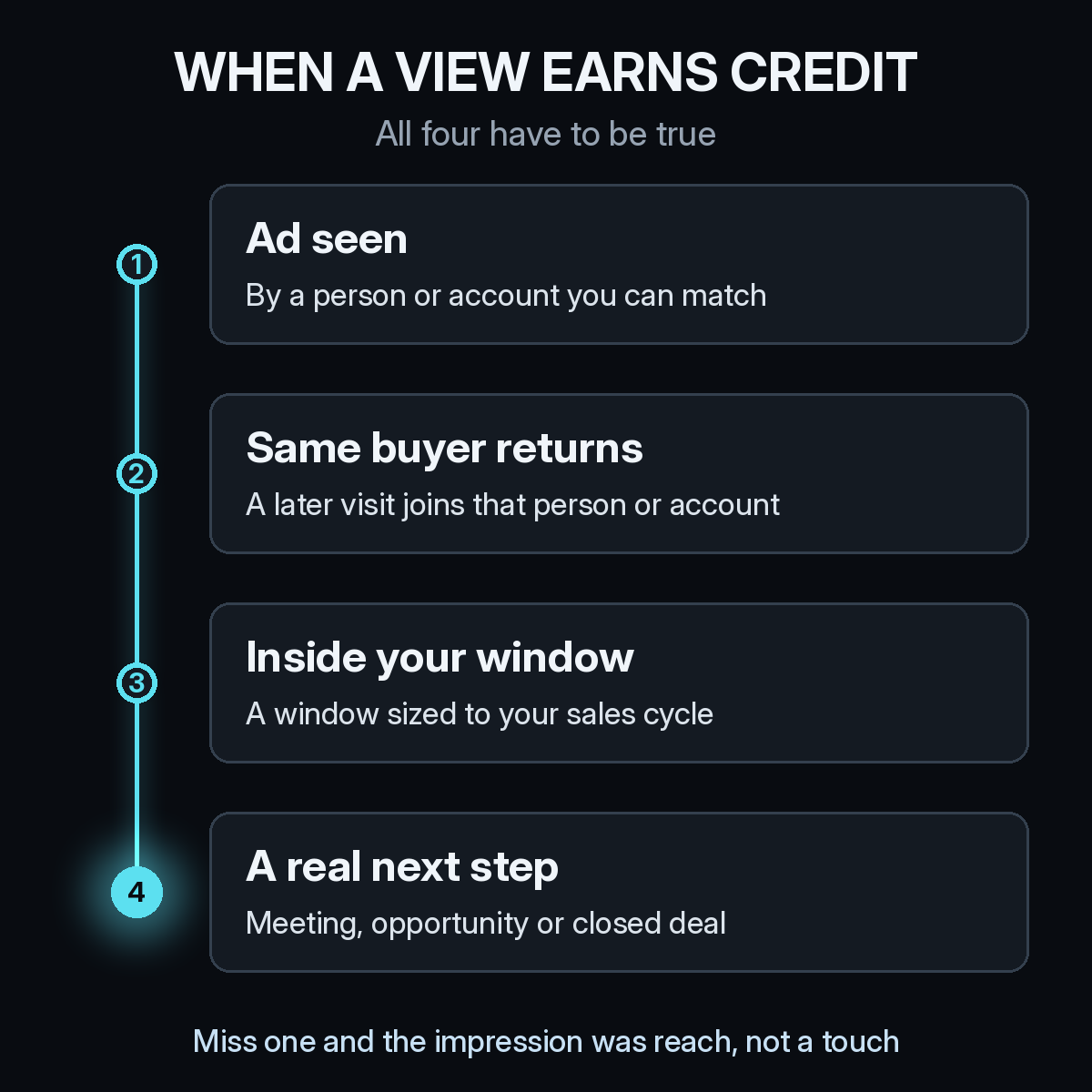
Most view-through attribution mistakes come from one habit: giving deal credit to every ad impression that ran near a buyer, whether or not that buyer ever came back. In B2B, a view should only earn credit when you can match it to a person or account, that same buyer returns inside a sensible window, and the return leads to a real next step like a meeting or an opportunity. With those rules in place, view-through is one of the most useful signals you have for paid social. Without them, it inflates every ad report you send to finance.
We explained the basics in what view-through attribution means in B2B. This post is the follow-up: the six mistakes we see most often, and what to do instead.
Should every impression get view-through credit?
No. This is the first and biggest mistake. An impression is proof that an ad was served, not proof that anyone read it. If you give credit to every impression that reached someone at a company that later bought, paid social will look like it touched almost every deal, because it probably did serve an ad to someone there.
The fix is to treat a view as a candidate touch, not a touch. It only joins the buyer path when a later visit from the same person or the same account shows up. Without that return visit, the impression was reach. Reach matters for brand, but it does not belong in pipeline credit.
How long should a view-through window be for B2B?
The second mistake is keeping whatever window the ad platform shipped with. Platform defaults are built for the platform's own reporting, and they rarely match how long your buyers take to move. A window that is too short drops real influence. A window that is too long lets an ad from last quarter claim a deal it had nothing to do with.
Pick the window from your own data. Look at how long it usually takes from a first visit to a booked meeting, and set the view window shorter than your click window, since a view is a weaker signal. Our guide to choosing an attribution window for long B2B sales cycles walks through how to set one and how to check it later.
Why do ad platforms and your CRM disagree on view-through conversions?
Mistake three is trusting platform-reported view-through conversions as if they were pipeline. LinkedIn Ads, Meta Ads and Google Ads each count conversions they can see from their side, often a form fill or a page view, not a qualified opportunity. Those numbers can be fine for optimizing a campaign. They are not a pipeline report.
Mistake four follows from it. Each platform counts its own views, so one deal can be claimed by three platforms at once. Add up the platform dashboards and you get more attributed pipeline than you actually created.
The fix for both is the same: put every touch on one path, tied to contacts and deals in your CRM, such as HubSpot, and split credit once across that path. A deal is a deal. It gets credited one time, no matter how many ad networks served an impression along the way.
Can a view-through touch be tied to an account instead of a person?
Often it has to be. In B2B, the person who saw the ad is frequently not the person who fills in the demo form. A director scrolls past a LinkedIn ad, then a manager on the same team visits the pricing page a week later. If you only match on the individual, that view disappears.
Account-level matching helps, but it can also become its own mistake if the match is loose. A view should join the account path only when you can tie it to that account with confidence, and it should still be followed by real activity from that account. We covered how anonymous visits get connected to known people and companies in how identity resolution connects anonymous visits to B2B pipeline.
Should a view get the same weight as a click?
Mistake five is weighting views and clicks equally. A click shows intent in the moment. A view shows that an ad was on screen. Both can belong on the path, but a view should carry less weight in a multi-touch model, so a campaign full of cheap impressions cannot outscore the touches where a buyer actually acted.
Mistake six is never checking whether the views matter at all. Every so often, hold out a slice of your audience or a region from a campaign and compare how many opportunities each group creates. That tells you whether view-through credit reflects real lift or just ads served to people who were going to buy anyway. Our guide on running an incrementality test without losing the deal path covers how to set one up.

What does a trustworthy view-through report look like?
It shows views and clicks on the same path, with views clearly labeled. It counts a view only when the same person or account came back inside the window and something real happened next. It reports pipeline and closed revenue from your CRM, not platform conversions. And it lets you see paid social with and without view-through credit, so the team can judge the difference for themselves.
Once that report exists, budget conversations get calmer. You can show which campaigns started conversations that turned into opportunities, and which ones only produced impressions. It also makes reading CAC by channel far more honest, since paid social stops borrowing credit from deals it never influenced.
How Source handles view-through attribution
Source installs with one pixel or Google Tag Manager, with no data warehouse to build. It records every visit, connects the path to contacts and deals in your CRM, and includes view-through attribution alongside multi-touch, offline, and LLM attribution for traffic from ChatGPT, Claude, Perplexity and Gemini. You see real CAC, goals, and channel quality on one path, so a view is credited once and next to the touches around it.
You can chat with your data to ask which campaigns earned view-through credit this quarter, get AI recommendations, and receive daily Slack reports. Source is SOC 2 Type II and ISO 27001 certified, and customer data is not used to train external models.
If your paid social numbers look too good to be true, start free at dash.source.app/signup and see what your views are really doing.