


Episode 1: David Dorman on PLG, open source monetization, and why attribution still sucks
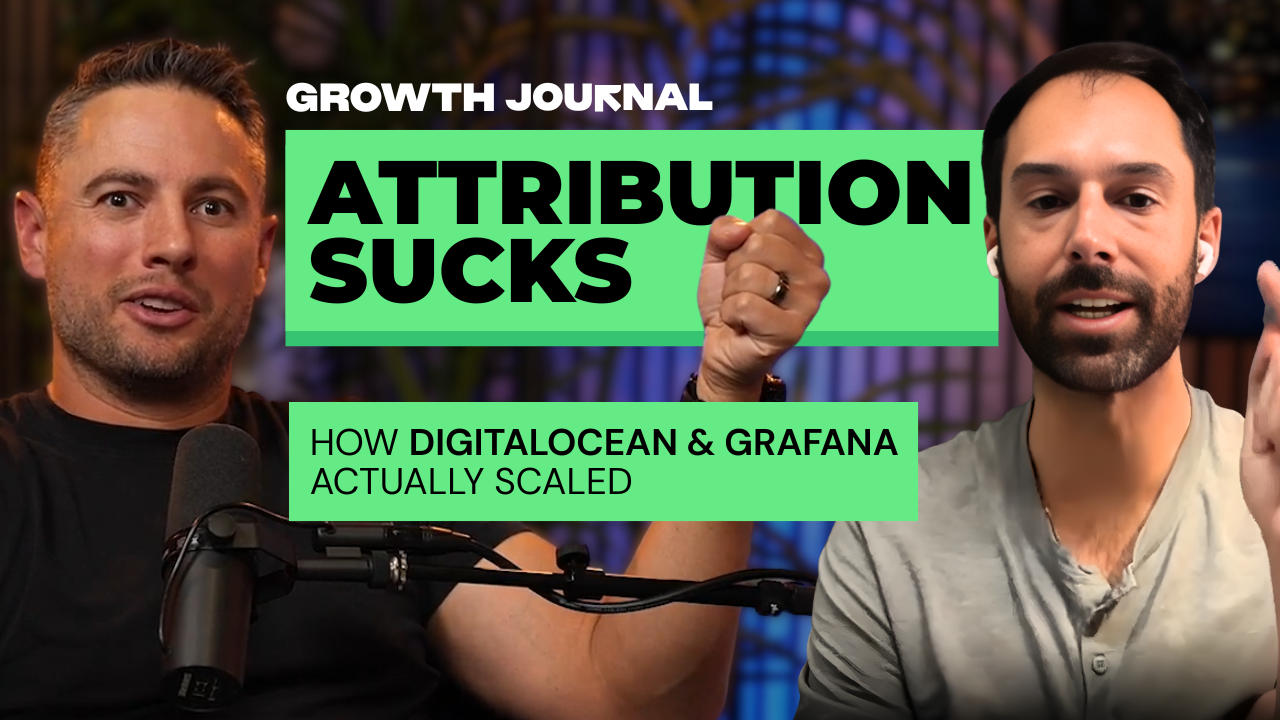
Who Dave is and why his perspective matters
Dave joined DigitalOcean shortly after the Series A as the first product marketer, but the role was really a hybrid: product marketing, conversion rate optimization, demand gen, and whatever else the company needed to move from hobbyist usage to “this runs my business.”
At Grafana, he was brought in to help answer a classic open source question: how do you take millions of open source users and build a scalable self-serve revenue engine, without losing what made the community and product work in the first place?
Now, he is at Modal, an AI infrastructure platform helping developers train models, run inference, and execute workloads on GPUs in a serverless way. He joined because he believes infrastructure remains one of the most durable ways to build a massive business, and AI is reshaping what “infrastructure” even means.
The throughline: offer real value, then be “long-term greedy”
DigitalOcean and Grafana are very different companies, but Dave kept coming back to the same concept: win trust by giving people something genuinely useful, then let compounding do its thing.
At DigitalOcean, that value was tutorials and documentation. A developer could show up with a specific problem (“how do I install X?”), get a perfect answer, and leave without signing up. That was not a failure. DigitalOcean earned goodwill and got “in-market” positioning for the next time that developer needed hosting.
At Grafana, the value was the open source product itself. The company built a massive top of funnel by shipping software developers loved, then used time, product packaging, and a freemium SaaS motion to monetize a small sliver of that giant base.
“Offer value. Really win. And you’ll see the gains later.”
This is the part most teams intellectually agree with, but emotionally struggle with, because the conversion does not happen in the same session. Dave’s point is simple: compounding beats impatience.
DigitalOcean vs Grafana: you cannot copy and paste a playbook
One of my favorite parts of the conversation was Dave’s reminder that “successful playbooks” do not transfer cleanly.
DigitalOcean’s growth engine was heavily content-led. Grafana’s growth engine was open-source-led, supported by community, conferences, and an ecosystem tailwind (Kubernetes → Prometheus → Grafana as the visualization layer).
Those engines rhyme, but they are not the same.
The shared lesson is not “do content” or “do open source.” The shared lesson is: build a distribution advantage that is genuinely helpful to the user, and then design the business around that advantage.
How Grafana monetized open source: from one project to a suite
When people ask “how do you monetize open source?”, they often expect a single trick. Dave’s answer is more structural.
Grafana monetized by becoming more than a single project. Grafana expanded into a suite of projects (metrics, logs, traces, long-term storage, and more), then packaged the experience into a SaaS offering that was more integrated, more “batteries included,” and easier to run at scale than stitching the Legos together yourself.
Yes, there are classic enterprise features (RBAC, audit logs, compliance), but the real lever was product value that made the hosted experience meaningfully better.
PLG vs product-led sales: the hybrid is the real world
Grafana is a great example of how messy the real world is:
- Awareness and adoption were massively product-led (open source distribution).
- Monetization, especially early, leaned more sales-led for big enterprise contracts.
- Over time, the company pushed harder toward a modern hybrid: self-serve expansion with the right moments for sales-assist.
The key is not ideology. The key is designing handoffs and “human moments” that actually add value, instead of forcing demos or forcing credit cards too early.
A concrete tactic: the freemium shift that unlocked compounding
I asked Dave for a tactical initiative that helped get more people swiping credit cards.
His best example was not a clever landing page or a one-week campaign. It was a structural shift:
- Grafana initially had no freemium, or used a credit-card-required trial.
- They tested a 30-day trial that required a credit card, and it performed poorly.
- They moved to a freemium model with real usage limits.
- Over time, tens of thousands of free-plan users became a compounding base, with a predictable percentage converting each month as needs grew.
This is the “long-term greedy” model in action: sacrifice short-term forcing functions, build an always-on entry point, and let product familiarity do the work.
Why attribution sucks (and is about to get worse)
This was the theme that kept coming back, including in the live brainstorming segment for Source.
Attribution breaks because:
- The journey is multi-touch and multi-channel, not a straight line.
- A huge portion of traffic shows up as direct or organic.
- Cookies and tracking degrade, especially in technical audiences.
- “Signals” that look exciting (sudden usage spikes) are often negative signals (misconfigurations, abuse, weird edge cases).
- CRM reporting is not built for the messy reality of modern journeys.
- Even when you build a model, you risk predicting “people who would have bought anyway,” which creates internal fights about ROI and credit.
And now, add the next wave:
- Answer engines and AI-assisted discovery change how people research.
- More interactions happen in places you do not control.
- Bots and agents will increasingly behave like users, contaminating top-of-funnel signals.
In other words: attribution is not getting easier.
“Attribution sucks. Everyone knows it.”
The Source segment: “Attribution sucks” as a real campaign
We ended the episode by jamming on growth ideas for Source, and we landed on a simple, punchy campaign concept:
Attribution sucks.
Everyone feels it. Few talk about it honestly. That honesty is the wedge.
The best part is that “attribution sucks” is not just a tagline. It is a doorway into education:
- Why it breaks
- What “good” looks like
- How to connect top-of-funnel signals to revenue outcomes
- How to give operators real-time clarity without waiting in a data-team queue
A few tactical ideas that came out of the brainstorm:
- Show up where the conversation already is: comment and contribute on LinkedIn threads and posts where attribution, PLG, and growth measurement are being debated.
- Build a simple manifesto landing page: what sucks, why it sucks, and what a modern revenue attribution stack needs to do.
- Run a focused “diagnostic” hook: a short assessment or benchmark that helps teams self-identify the gaps in their current measurement, then points to the next step.
- Make it memorable: memes, short clips, and simple visuals that capture the shared pain.
The takeaway for growth teams
If you only remember a few things from Episode 1, make them these:
- Compounding wins. The best growth systems feel slow at first, then become unfair.
- Distribution must be real value. Content, open source, community, product, it does not matter which, it matters that it truly helps.
- Freemium is not a tactic, it is a strategy. If your product supports it, it can build an always-on engine.
- Do not get fooled by “spikes.” In consumption businesses, sudden growth can be a trap.
- Attribution is a revenue problem, not a marketing vanity problem. If it does not tie to pipeline and outcomes, it is theater.
What’s next
This is Episode 1, and we are going to practice what we preach.
We are going to test the “Attribution sucks” direction, instrument it, and report back with what happened. If it works, we scale it. If it fails, we learn fast and move.
That’s the premise of The Growth Journal: real operators, real experiments, real results.