


Episode 2: Bill Macaitis on B2B Brand, Freemium Growth, Product-Led Sales, and Why Attribution Still Breaks
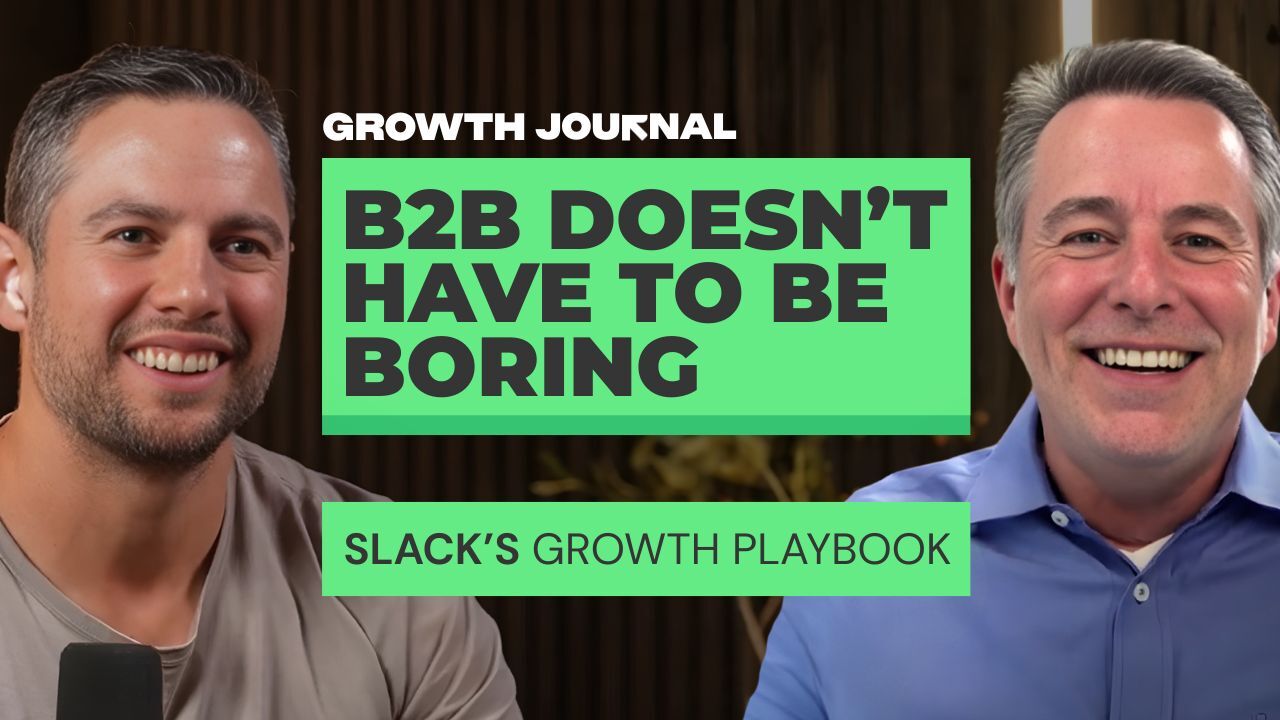
In Episode 2 of The Growth Journal, Mitch Wainer sits down with Bill Macaitis, former CMO of Slack and Zendesk, and former SVP of Marketing at Salesforce, to unpack what actually drives B2B growth when markets get crowded, distribution gets weaponized, and measurement gets messy.
Bill shares hard-earned lessons from scaling iconic SaaS brands, plus practical frameworks you can apply whether you run marketing at a startup or lead growth inside an enterprise org.
Who is Bill Macaitis?
Bill is one of the most influential modern B2B marketing leaders, known for helping build the brand and growth engines behind companies like Slack, Zendesk, and Salesforce. Today, Bill spends his time advising and mentoring leaders across SaaS and AI, and producing content through his YouTube channel SaaS CMO Pro, where he teaches growth and go-to-market topics from the operator’s perspective.
What you’ll learn in this episode
This conversation covers:
- Why “serious enterprise marketing” is often a trap
- How Slack evolved pricing and packaging into a growth engine
- The mechanics of product-led sales and product-qualified leads (PQLs)
- Product moat vs distribution moat, and what Microsoft Teams taught the market
- Why SEO is changing and what “AEO” and AI discovery mean for B2B
- How to stay creative as a marketing leader without relying on “genius ideas”
- Why attribution is still broken, and how great teams compensate
The biggest early-career B2B marketing mistake: acting like humans are not humans
Bill’s first major belief shift in B2B marketing is simple:
People are people, even in enterprise.
Early in his B2B career, Bill felt pressure to be overly formal, conservative, and “suit-and-tie serious.” Over time, he learned that the brands that win in crowded SaaS categories tend to do the opposite:
- Speak like real humans
- Avoid jargon and acronym soup
- Make customers feel something (smile, curiosity, delight)
- Create a recognizable personality
Practical takeaway: “Lean into your name”
Bill and Mitch both point to a pattern: brands become more memorable when they commit to their identity. DigitalOcean’s ocean theme and mascot is a great example. Bill shares a simple prompt you can use internally:
If your company name suggests a visual, a theme, a mascot, or a tone, commit to it.
The Slack lesson: pricing and packaging is a growth lever most teams underuse
When Bill moved from B2C to B2B, he noticed something strange: many B2B companies made it hard to even try the product. The default pattern was “contact sales,” gated access, short trials, and limited value before purchase.
At Slack, that evolved into a clearer point of view:
Slack’s freemium philosophy
Instead of heavily feature-gating the free plan, Slack made the product broadly usable, then reserved paid upgrades for capabilities that mattered most to larger orgs, like:
- SSO and security controls
- Provisioning and deprovisioning users
- Compliance and exports
- Consolidated billing
- Enterprise-grade support and reliability expectations
In other words, Slack aimed to maximize product experience first, then monetize on enterprise requirements.
Why it works
Bill’s mental model is useful for any product-led motion:
The more people using your product, the more “marketing team members” you have.
Freemium users become distribution, referrals, and internal champions. Even though free users have a real cost (support, compute, bandwidth), Bill argues it can still be dramatically cheaper than trying to buy the same awareness through events or big ad spends.
Practical takeaway for B2B founders and CMOs
If pricing and packaging has not been revisited since your early days, you may be sitting on one of the highest-leverage growth opportunities in your business.
Ask:
- Who owns pricing today, explicitly?
- What is the true friction to experiencing value?
- Are you gating the right things (enterprise requirements vs core value)?
- Is your “trial” actually usable, or just a demo disguised as a product?
Product-led sales: let the product qualify the lead, not the form
Bill explains how Slack moved away from the old model of gating everything behind forms and SDR follow-up. Instead, they leaned into product-led sales, where usage signals determine when sales reaches out.
What is a Product-Qualified Lead (PQL)?
A PQL is an account or user that crosses thresholds in-product that indicate real value and likely conversion, such as:
- Rapid user growth inside a team
- Consistent weekly engagement
- Expanding across departments
- High-intent actions tied to long-term adoption
Bill also highlights a powerful nuance:
Use NPS to find your internal champion
Rather than always starting with “the admin,” Slack would look for the people who loved the product most (for example, NPS 10/10 respondents) and use them as:
- Internal advocates
- Connectors to procurement
- Expansion catalysts across teams
- Potential testimonials
Practical takeaway
If you have product usage data but still run go-to-market like it’s 2012, you are likely missing a cleaner, cheaper path to pipeline.
Product moat vs distribution moat: Slack vs Microsoft Teams, and the lesson for AI
Mitch asks the question every founder eventually faces: is the bigger moat product or distribution?
Bill’s answer is balanced:
- Both are real
- Both matter
- Distribution is often underestimated, especially by product-driven founders
In Slack’s case, Microsoft’s distribution advantage was massive, amplified by bundling Teams into existing enterprise agreements. Bill also notes that Salesforce acquiring Slack was strategically meaningful because Salesforce brought stronger distribution reach.
Why this matters right now
Bill ties this directly to the AI market:
- Product leadership can create a first-mover advantage
- Distribution from platforms (Google, Meta, Microsoft) can change the competitive math fast
- The “best product” does not always win if distribution is asymmetrical
Practical takeaway
If you are building a category-defining product, treat go-to-market innovation as a product problem. Build the distribution engine with the same urgency as the roadmap.
The new top-of-funnel: from SEO to AEO and “follow the eyeballs”
Bill calls out a major shift that many B2B companies are already feeling:
AI answers reduce link clicks.
If your growth has relied heavily on classic SEO, you need to adapt. Bill describes the emerging reality:
- Buyers increasingly consume answers inside AI tools, not search results
- Discovery can come through sources AI models “trust,” like community conversations, high-signal reviews, and credible third-party mentions
- The content formats that win attention are shifting toward short-form video and creator-driven distribution
“Follow the eyeballs”
Bill’s B2C-rooted advice is straightforward:
- People spend time on phones
- Attention is concentrated in social feeds and video
- B2B teams should treat video as a primary distribution channel, not a “nice-to-have”
He also notes that AI tools are making video production dramatically easier: clipping, captions, distribution, repurposing long interviews into short segments.
Practical takeaway for B2B marketers
If your content strategy is still anchored on long PDFs and gated whitepapers, you may be building for a world that is rapidly disappearing.
How to stay creative as a marketing leader
Mitch asks Bill how he consistently produces creative campaigns and brand work.
Bill’s answer is not “be a genius.” It’s more useful:
- Get inspiration outside your category
- Borrow patterns from B2C
- Look at mobile onboarding, consumer UX, entertainment, creators
- Challenge the “B2B must be boring” assumption
- There is a spectrum between playful and unserious
- Distinct does not mean untrustworthy
- Build a culture where ideas can compound
- Encourage teams to build on ideas instead of shooting them down
- Mitch shares a memorable offsite lesson: replace “no” with “yes, and…”
Practical takeaway
Creativity is often a system, not a personality trait. The best marketing teams create an environment where more ideas survive long enough to become great.
Attribution is still broken, and great teams compensate in different ways
Bill is blunt: attribution is one of the hardest, most political parts of marketing, and it remains in a “sorry state.”
He explains why:
- Enterprise deal cycles are long (6 to 24 months)
- Touchpoints are messy (ads, events, partners, product usage, word of mouth)
- Traditional models often over-credit a single team or a single touchpoint
- Security constraints can force teams to build systems in-house, which is painful
What Bill used when attribution failed
Bill shares a practical workaround from Slack:
- Geo testing with control groups
- Run campaigns in select regions and compare against regions that did not receive the campaign
- Measure lift across brand, awareness, leads, and pipeline
He also emphasizes brand measurement, including:
- Aided awareness
- Unaided recall
- Sentiment and share of conversation
Practical takeaway
If you cannot credibly answer “did this work,” your influence shrinks. Better measurement is not just analytics, it is how marketing earns the right to invest.
Bill’s Growth Journal challenge: the “Attribution Sucks” homepage test
In the episode’s growth experiment segment, Bill proposes a bold, simple test:
Put a massive banner on the homepage that says:
“Attribution sucks.”
Then immediately follow with: “There’s a better way.”
Mitch reveals that the show’s Episode 1 guest had a similar idea, and they already secured attributionsucks.com as part of a broader awareness campaign.
Why this test is interesting
- It is instantly clear
- It is emotionally resonant for the ICP
- It creates curiosity and self-identification
- It can be tested quickly with measurable outcomes
Key quotes and ideas worth remembering
- “People are people.” Enterprise buyers still respond to human brands.
- Pricing and packaging is strategy. Many teams set it once and never revisit it.
- Freemium can be a marketing engine. Free users can become your distribution channel.
- Product-led sales requires real usage signals. Not just form fills.
- Distribution is a moat. Ignore it and you may lose to bundling and reach.
- Video is becoming the default attention format. AI makes production and repurposing faster.
- Attribution is credibility. If you cannot measure impact, you lose budget and influence.
Listen to Episode 2 and explore more Growth Journal posts
This blog post is part of The Growth Journal series, where Mitch interviews top growth leaders and then tests real experiments inside Source, the marketing attribution platform built for modern B2B teams.
Explore more episodes at source.app/growth-journal and follow along as we run the experiments, measure results, and share what actually works.
FAQ: quick answers from Episode 2
What is product-led sales?
A go-to-market approach where sales engagement is triggered by in-product usage signals (PQLs), not just form submissions or outbound lists.
What made Slack’s freemium model effective?
Slack made the free product genuinely useful, then reserved paid upgrades for enterprise requirements like security, provisioning, compliance, and consolidated billing.
Is a product moat or distribution moat more important?
Both matter. Great products can win early, but strong distribution can dominate markets, especially when bundling and platform reach come into play.
How is SEO changing for B2B SaaS?
AI-driven answers reduce link clicks, which can hurt traffic for teams relying on organic search. Discovery is shifting toward trusted sources, communities, reviews, and content formats like video.
Why is B2B attribution so hard?
Long deal cycles, many touchpoints, offline channels, partner influence, and cross-device behavior make single-touch models unreliable and politically contentious.