


B2B attribution glossary: the terms your team will hear

A B2B attribution glossary is a short list of the terms your team uses to say which marketing touches deserve credit for pipeline and revenue. The words that matter most fall into four groups: the basics (touchpoint, conversion, attribution window), the model names (first touch, linear, W-shaped and the rest), the tracking terms (UTMs, click IDs, identity resolution), and the CRM terms (lead source, sourced pipeline, CAC).
Teams argue about attribution more often because they use the same word for different things than because the data is wrong. Here is each term in plain English, with links to our longer guides where a term deserves more than a paragraph.
What are the basic attribution terms?
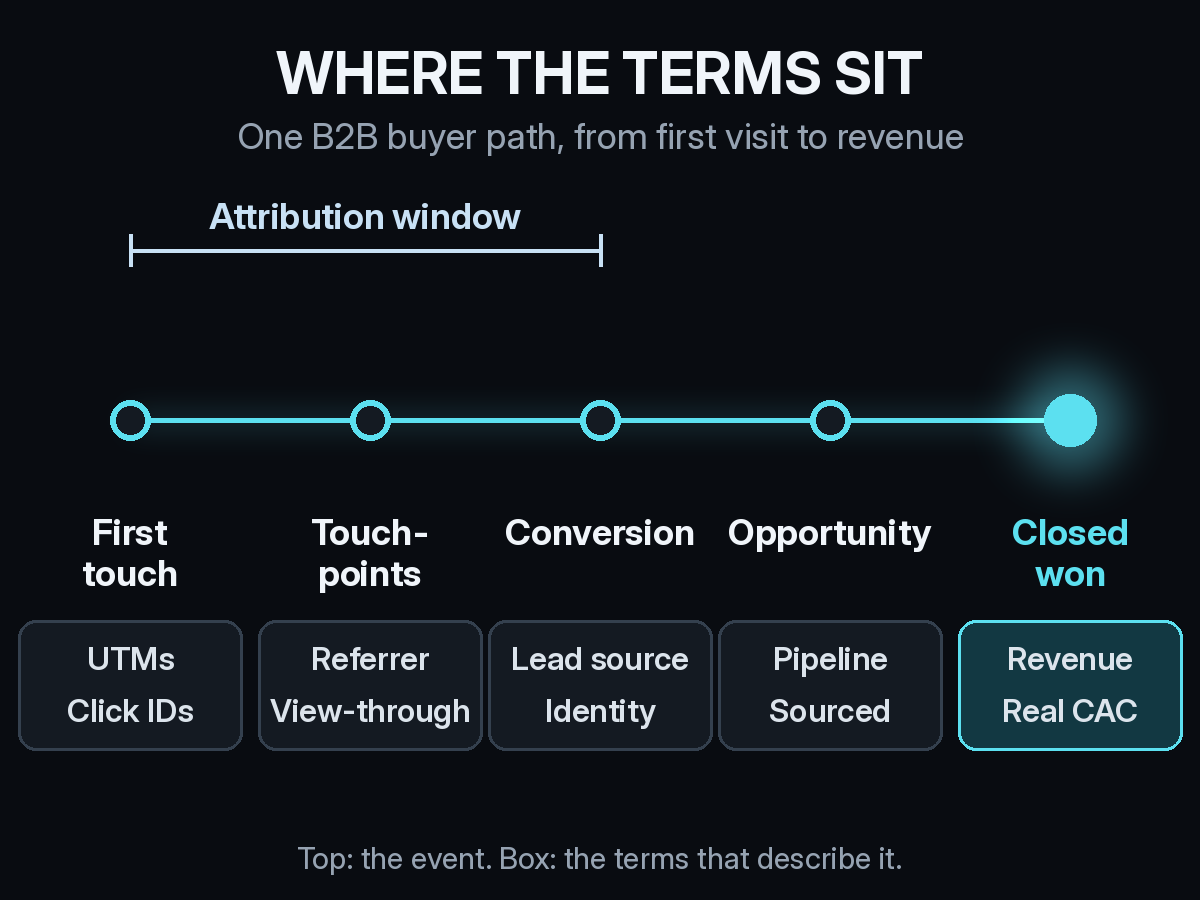
Touchpoint. Any recorded interaction between a buyer and your company: an ad click, a blog visit, a webinar, a demo call. Attribution can only credit touchpoints it can see.
Conversion. The action you are trying to explain. In B2B it is usually a signup, a demo request, or a form fill, and it is rarely the same thing as revenue.
Attribution model. The rule that decides how credit for a conversion or deal is split across touchpoints. Change the model and the same journey tells a different story.
Attribution window. How far back from a conversion a touch can still earn credit. You will also hear lookback window or conversion window. Long sales cycles make this setting matter a lot, which we cover in the attribution window, explained for long B2B sales cycles.
Buyer journey. The full sequence of touchpoints for one person or one account, from first visit to closed deal.
What do the attribution model names mean?
Single-touch attribution. Any model that gives all the credit to one touch.
First touch. All credit to the earliest recorded touch. Good for seeing what creates awareness, weak at showing what moves a deal.
Last touch or last click. All credit to the final touch before the conversion. It is the default in many ad platforms and the main reason branded search and Direct look so strong.
Multi-touch attribution. Any model that spreads credit across several touches. Our guide to how multi-touch and single-touch attribution credit a deal walks through one journey both ways.
Linear. Equal credit to every touch on the path.
Time decay. More credit to touches closer to the conversion, less to the early ones.
U-shaped or position-based. Most of the credit goes to the first touch and the touch that created the lead, with the rest shared across the middle.
W-shaped. Like U-shaped, with a third heavy touch at the moment an opportunity is created. It suits B2B teams that track pipeline stages carefully.
Data-driven attribution. Credit set by a statistical model trained on your own conversion paths, as in Google Ads. It needs a lot of conversions to be reliable, which many B2B accounts do not have.

Which tracking terms come up most?
UTM parameters. Tags added to a link, such as utm_source and utm_campaign, that tell your analytics where a visit came from. Inconsistent naming is the most common way good traffic ends up unlabeled. See UTM mistakes that send B2B deals to Direct.
Click ID. A unique identifier an ad platform appends to a click, like gclid from Google or li_fat_id from LinkedIn. Saving it on the first visit lets you match a deal back to the exact ad.
Referrer. The page or site a visitor came from, passed by the browser. It is how you can tell a visit came from a review site or an AI assistant even without UTMs.
Tracking pixel or tag. A small script on your site that records visits and events. Most teams install it directly or through Google Tag Manager.
Identity resolution. Joining a buyer's earlier anonymous visits to their record once they sign up or fill out a form. Without it, weeks of research disappear from the path. More in how identity resolution connects anonymous visits to B2B pipeline.
View-through attribution. Credit for an ad someone saw but did not click, when they later convert. Our view-through attribution guide explains when it is fair to count.
Direct traffic. Visits with no referrer or tags. In practice it is a bucket for anything tracking missed, not proof that people typed your URL.
Which pipeline and revenue terms tie attribution to the CRM?
Lead source. A single field in your CRM, such as HubSpot or Salesforce, that records where a contact came from. It is usually set once, which makes it a first-touch or last-touch view whether anyone chose that or not.
Marketing-sourced pipeline. Opportunities where marketing created the first meaningful touch or the lead itself.
Marketing-influenced pipeline. Opportunities where marketing touched the account at any point before or during the deal. It is always the bigger number, so say which one you mean. If sales and marketing both claim a deal, our piece on when sales and marketing both claim the same deal can help settle the rules.
Closed-won revenue. Deals that signed. This is the number attribution should ultimately explain.
CAC (customer acquisition cost). What it cost to win a customer. Real CAC includes people and agency costs, not only ad spend. See how to read CAC by channel when B2B deals take months.
Channel quality. How often traffic from a channel turns into deals, not just leads. A cheap channel with no closed deals is not cheap.
What do the newer attribution terms mean?
Self-reported attribution. Asking buyers how they heard about you, usually with a free-text field on the demo form. It catches podcasts, communities, and referrals that no tag can see. Our self-reported attribution checklist covers wording and grouping.
Dark social. Sharing that happens in places tracking cannot follow, like Slack groups, DMs, and group chats. It usually shows up as Direct.
LLM attribution. Tracking visits and deals that start in AI assistants such as ChatGPT, Claude, Perplexity, and Gemini. Read how LLM attribution handles ChatGPT traffic for the details.
Offline attribution. Giving credit to touches that happen off your site, such as events, sales calls, and direct mail, by bringing them into the same path. See offline attribution for B2B.
Incrementality testing. Measuring whether a channel caused extra conversions, usually by holding back a group that does not see it. It answers a different question than attribution does.
Marketing mix modeling. A statistical model that estimates each channel's effect from spend and outcome trends over time, without tracking individual buyers.
Which terms do teams mix up most?
Three pairs cause most of the confusion. Lead source and first touch sound the same but are often set by different systems at different times. Sourced and influenced pipeline get reported interchangeably, which makes marketing look either far better or far worse than it is. And a conversion is not a deal, so a channel that drives signups may not drive revenue.
Writing down your team's definitions for these six words, and sharing them with sales and finance, prevents most attribution arguments before they start.
How Source puts these terms to work
Source installs with one pixel or Google Tag Manager, with no data warehouse to build. It records UTMs, click IDs, and referrers on every visit, joins anonymous visits to the person once they convert, and connects the full path to contacts and deals in your CRM. You get multi-touch, view-through, offline, and LLM attribution, plus real CAC, goals, and channel quality in one place.
You can chat with your data, get AI recommendations, and receive daily Slack reports. Source is SOC 2 Type II and ISO 27001 certified, and customer data is not used to train external models.
Start free at dash.source.app/signup and see every term on this page applied to your own pipeline.