


Building next year's B2B marketing budget from attribution data

To build next year's B2B marketing budget from attribution data, start with closed revenue and pipeline by channel over at least one full sales cycle. Then sort every channel into scale, keep, fix, or cut before you move a dollar. Leads and clicks show you what was cheap. Marketing attribution shows you what turned into deals, and a budget should follow that.
Most B2B teams set their 2027 numbers in October and November, and the usual starting point is this year's spend plus or minus a percentage. The process below starts from the buyer's path, so the channels that actually started and moved deals get the money.
What attribution data do you need before you set a budget?
Pull five numbers for each channel, covering the last 12 months or one full sales cycle, whichever is longer. A deal that closed in September may have started with a podcast in March. If your reporting window is shorter than your sales cycle, the early channels lose their credit. Our explainer on the attribution window for long B2B sales cycles covers how to set it.
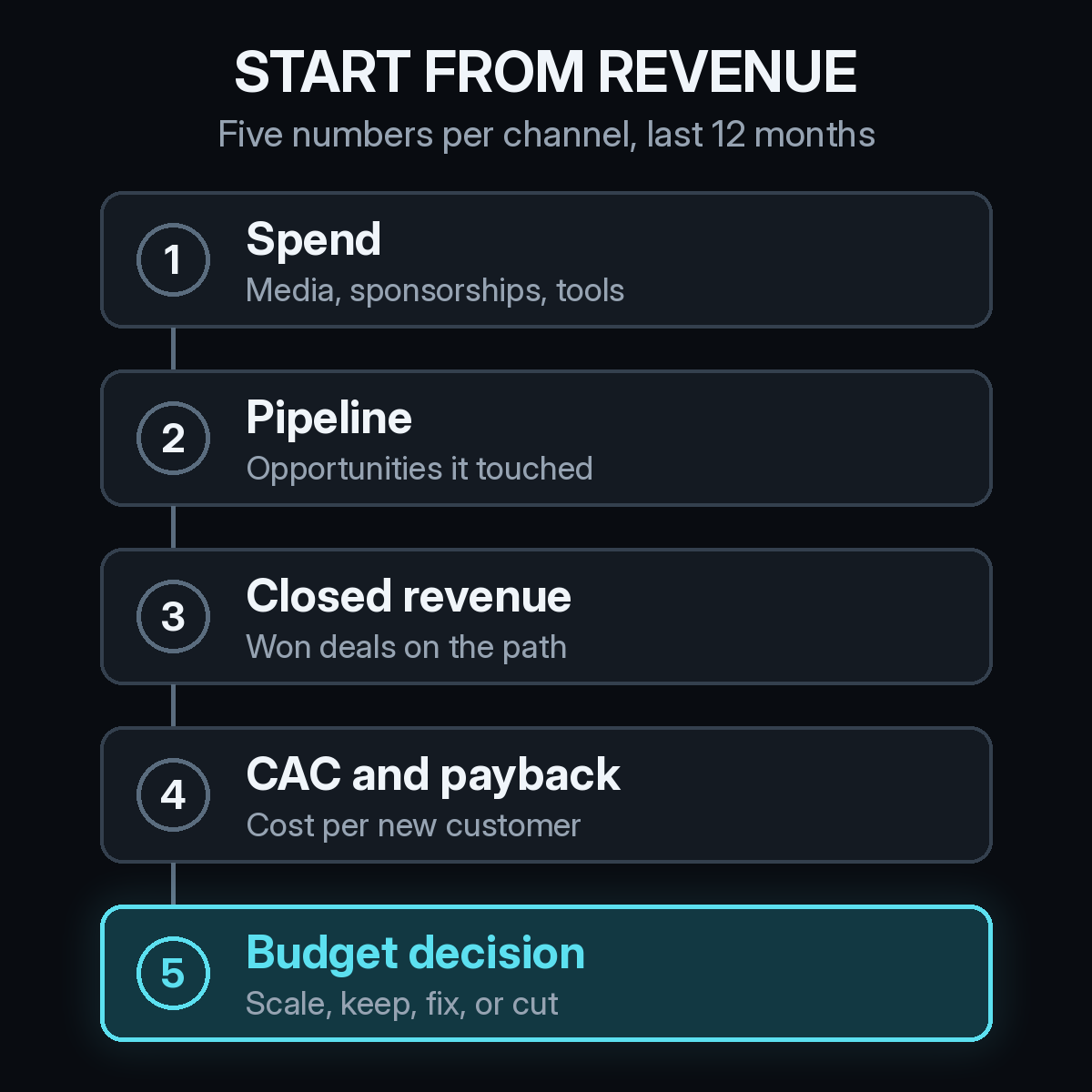
- Spend. Media, sponsorships, tools, and agency fees for the channel.
- Pipeline. Opportunities the channel touched, with multi-touch credit.
- Closed revenue. Won deals where the channel sits on the path.
- CAC. Spend divided by the new customers credited to the channel.
- Payback. Months of gross margin it takes to earn that CAC back.
Use multi-touch credit for this exercise. A last-click report hands most of the budget to branded search and the demo request page, because that is where buyers finish. The channel that introduced them gets nothing. We wrote more about this in how to read CAC by channel when B2B deals take months.
How do you rank channels for next year?
Ask two questions of every channel. How much pipeline does it create per dollar? How often does that pipeline close? Plot the answers and each channel lands in one of four boxes.

- Scale. High pipeline per dollar and a healthy win rate. Add budget in steps and check that pipeline per dollar holds as spend grows.
- Keep. Small volume, but the deals close. Brand, community, and partner programs often sit here. Hold spend steady.
- Fix. Plenty of pipeline, few wins. Look at targeting, lead quality, and the handoff to sales before you add or remove money. Often the ad platform is optimizing for the wrong conversion, which we covered in why cost per lead is the wrong first number for B2B paid ads.
- Cut. Little pipeline and few wins after a full cycle. Move that money to a test or to a Scale channel.
Before you cut anything, confirm the channel was measured fairly. A channel with weak numbers and broken tracking belongs in Fix until the tracking is repaired.
What about channels that rarely get the last click?
Podcasts, events, LinkedIn video, and AI answers tend to start deals rather than close them, so in a single-touch report they look expensive. Add these inputs to the review before you judge them:
- View-through. Ads that were seen, not clicked, before a meeting happened. See what view-through attribution means in B2B.
- Self-reported attribution. The "how did you hear about us" answer on your demo form. Our self-reported attribution checklist covers how to collect it without bad data.
- Offline touches. Booth conversations, dinners, and meetings logged in your CRM. Attributing B2B pipeline to events and trade shows walks through the setup.
If a channel keeps showing up early on won deals across these sources, treat it as Keep at minimum, even when its last-click number is close to zero. The same logic applies to shows and sponsorships, and podcast attribution for B2B shows how to trace pipeline back to an episode.
How much budget should you hold back for tests?
Set aside a fixed test slice before you allocate the rest. We suggest starting around 10 percent. That funds a few experiments a quarter without starving the channels that already work.
Write down the success bar for each test before it starts: the pipeline you expect, by when, and what happens if it misses. New channels need a full sales cycle to show closed revenue, so judge them first on early signals such as meetings held and opportunities created, then on revenue once the cycle has passed.
How do you set channel goals finance will trust?
Give each channel a pipeline goal and a CAC ceiling instead of a lead target. Finance can check both against the CRM, whether that is HubSpot or something else. Then review the numbers every quarter and move money when they shift. Waiting for next year's plan to fix a channel that stopped working wastes three quarters of spend.

For paid search, set the goal in the same terms inside the platform. A Google Ads campaign tuned to a pipeline-stage conversion gives you a cleaner read at review time than one tuned to form fills. When the plan goes to leadership, use the same definitions you used in the budget. How to put marketing attribution on the board slide shows a format that holds up to questions.
Where should AI search sit in next year's budget?
Buyers now research vendors in ChatGPT, Claude, Perplexity, and Gemini before they visit your site. Those visits often arrive as Direct or with a thin referrer, so AI search looks smaller in most reports than it really is. Before you decide what to spend on content and AEO next year, count how many won deals had an LLM visit on the path. Our guide to attributing ChatGPT and other LLM traffic shows how to catch those visits.
How Source supports budget planning
Source installs with one pixel or Google Tag Manager, with no data warehouse to build. It connects visits, ad views, meetings, and closed deals across the tools you already run into one path per buyer, with multi-touch, view-through, offline, and LLM attribution on that path.
That gives you real CAC by channel, goals, and channel quality in one place. When you are deciding where next quarter's money goes, you can chat with your data or read AI recommendations, and daily Slack reports keep the numbers in front of the team between reviews. Source is SOC 2 Type II and ISO 27001 certified, and customer data is not used to train external models.
Start free at dash.source.app/signup and build next year's plan from the deals you actually won.